Longines Ultra Chron 1967

“The world’s  most accurate watch”

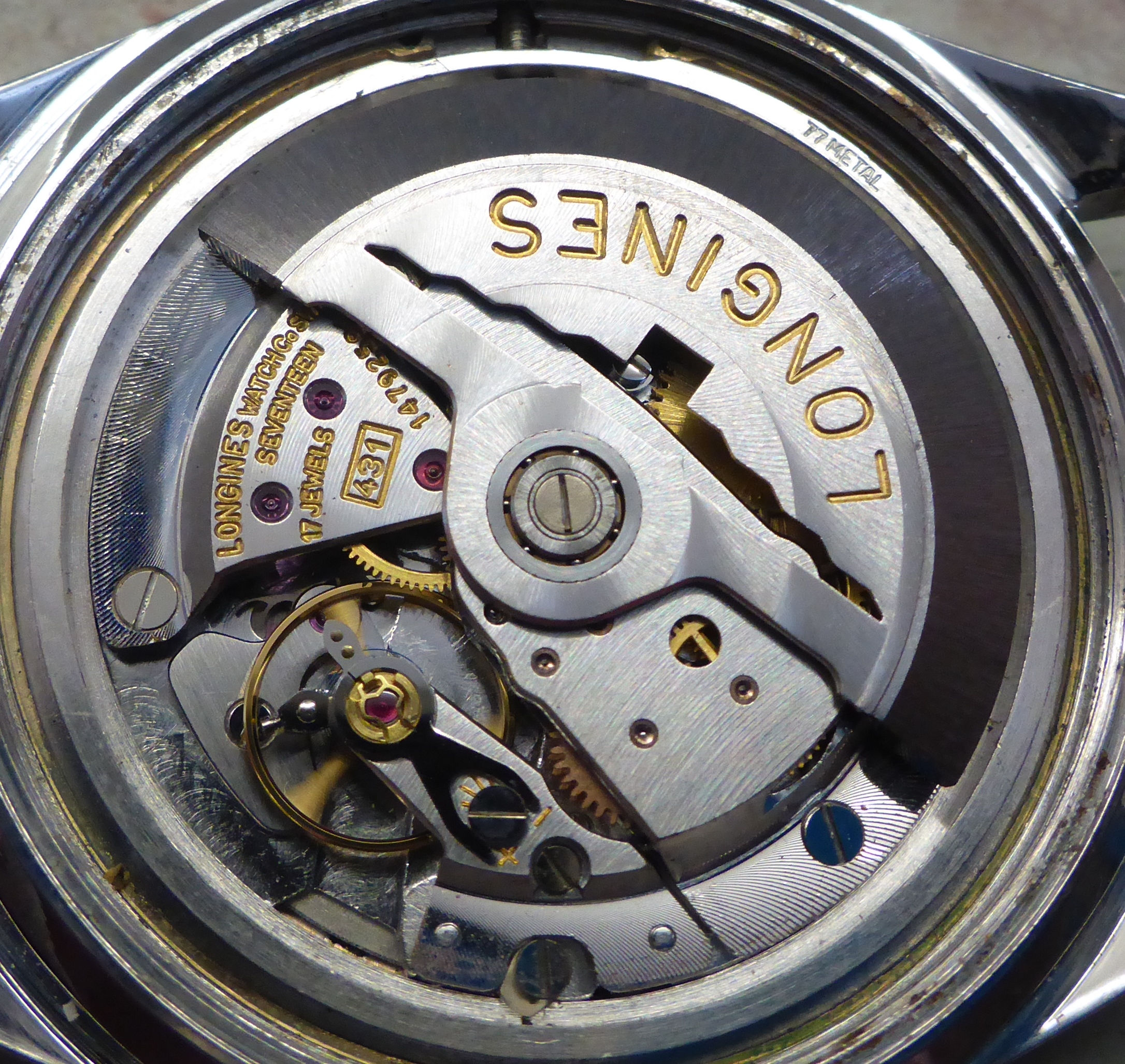
When released in 1967, the Longines boasted that it’s Ultra Chron was “The world’s most accurate watch”. A bold call! But, even bolder, they took the unusual step of specifying its accuracy to be within 1 minute a month……That’s 2 seconds a day! 

So, what did Longines do to achieve this phenomenal accuracy? Well, apart from designing a superbly efficient movement, the in house 431, they were one of the first to produce one that beat at 36000 beats per hour (bph). And, the higher the beat rate, the more potentially accurate the watch will be.

Longines weren’t the first to achieve this, Girard Perregaux did it a year earlier with their 32A movement and Seiko developed the manual wind 5740C also  in 1967. (I’m not sure whether it was Longines or Seiko who came second)
This watch is a nice 37 mm across the case (ex crown) and only 8.5 mm thick. It sits beautifully on an average wrist. The applied index markers, logos, date window and hands are all finished to the highest standard. Add to all of that a subtle  iridescent, off white dial with  a radially brushed finish and this watch presents most elegantly.

The hi beat movement also gives this watch a pleasant aesthetic quality as well. The second  hand moves much more smoothly than the lower beats do, almost gliding rather than ticking.

This watch also has one of my favorite features, the all too rare instantaneous date change. At around midnight the date will flick over to the next day instantly instead of crawling for over an hour or more.

During the 60s, the three most desirable watch brands were; Omega, Rolex and Longines. With models like this Ultra Chron it’s easy to see why Longines was part of that elite group.

:

Posted in Hi Beat Movement, Longines | Tagged , , , , , | Leave a comment

Vulcain Skeleton

Simply Beautiful!

Vulcain’s origin goes back as far as 1858 but is best known for the Vulcain Cricket introduced in 1947. The Cricket was the world’s first fully functional alarm wristwatch, quickly establishing the brand’s reputation as the “Presidents’ Watch” after being worn prominently by several U.S. Presidents including Eisenhower, Johnson and Nixon.

This unlabeled “skeleton” has nothing to do with the Cricket except that it is also manufactured by Vulcain.

The quality of the movement is superb and is reflected in the brilliant finish applied to the every aspect: the plates, wheels and highly polished screw heads. The case is also quality 20 micron gold plate.

It’s hard to date a watch like this but the square blocky hands, the equaly blocky index markers and the bulky case leaves me in no doubt that this was produced in the early 70s.

The movement is the rare, 22 jewel, automatic wind MSR T54. The MSR movements came into being in 1961 when a consortium of small manufacturers: Revue, Phenix, Berser and Vulcain collaborated to produce their own in house movements. The MSR T54 is quite low in profile at 5.1 mm thick. It features a ball bearing rotor, incabloc shock protection, fine screw adjusted regulator and a strange train and hand gear driven separately by the barrel. It is well engineered and very good quality. Of utmost importance, it is downright beautiful……and it needs to be if you are going to show the movement off, front and back!

Posted in Exhibition, Vulvain | Tagged , , , , | Leave a comment

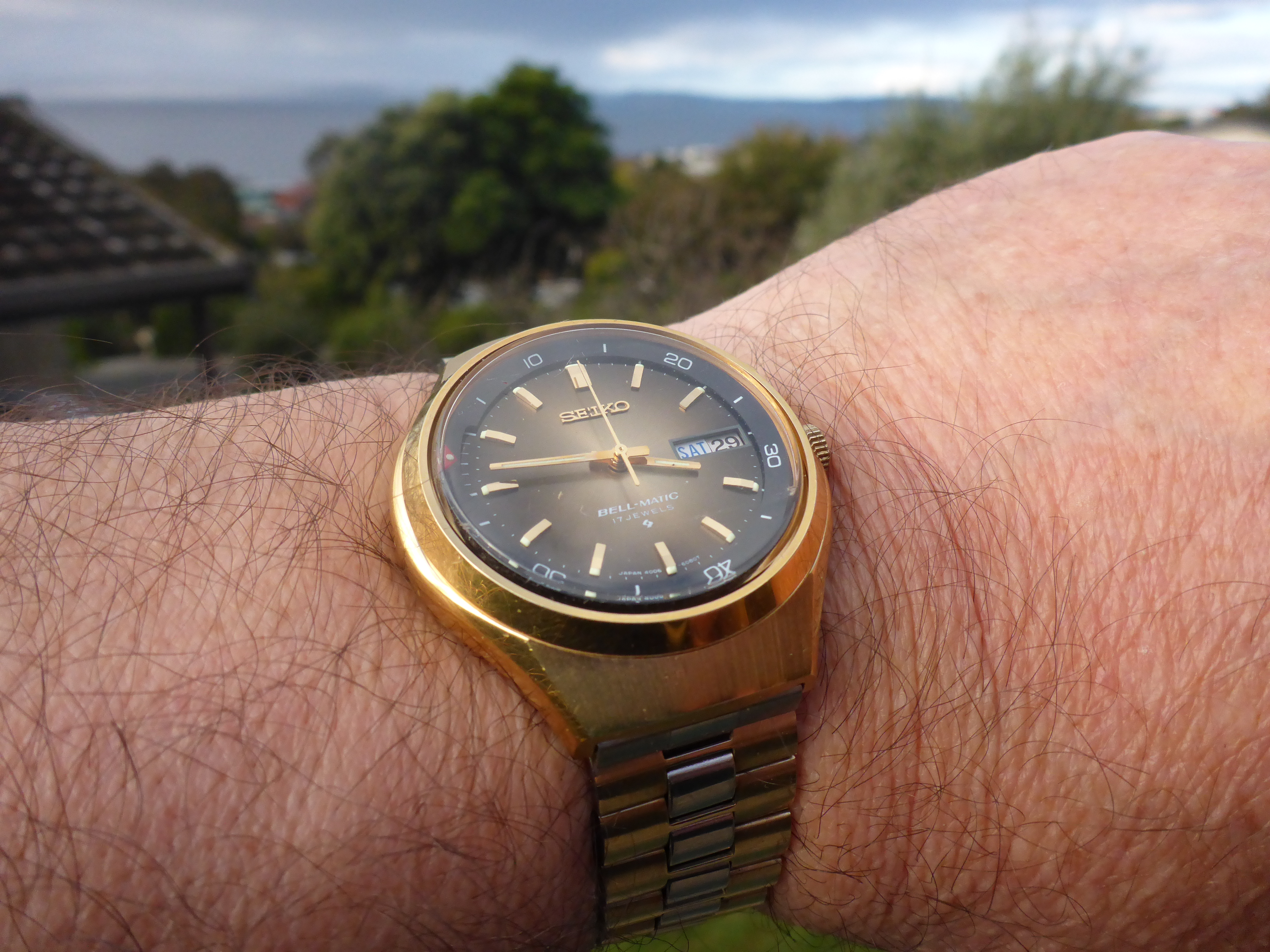
Seiko Bell-Matic 1977

The Bell-Matic featuring the rare alarm function, was released in 1966.  At the time there were other alarm watches in the market place, mostly hand wound and dominated by the generic AS 1475 and the 21600 bph version,  AS 1930. These movements were also “re-badged” and used in brands from the Soviet Poljot to Tissot, Bulova, Girard Perregaux and several more.

The “helmet style allows this watch to sit nicely and comfortably on the wrist

With automatic wind, day/date display, quick date change and modern syling including colourful dials, it wasn’t long before the Seiko Bell-Matic  dominated  this very small niche in the market .

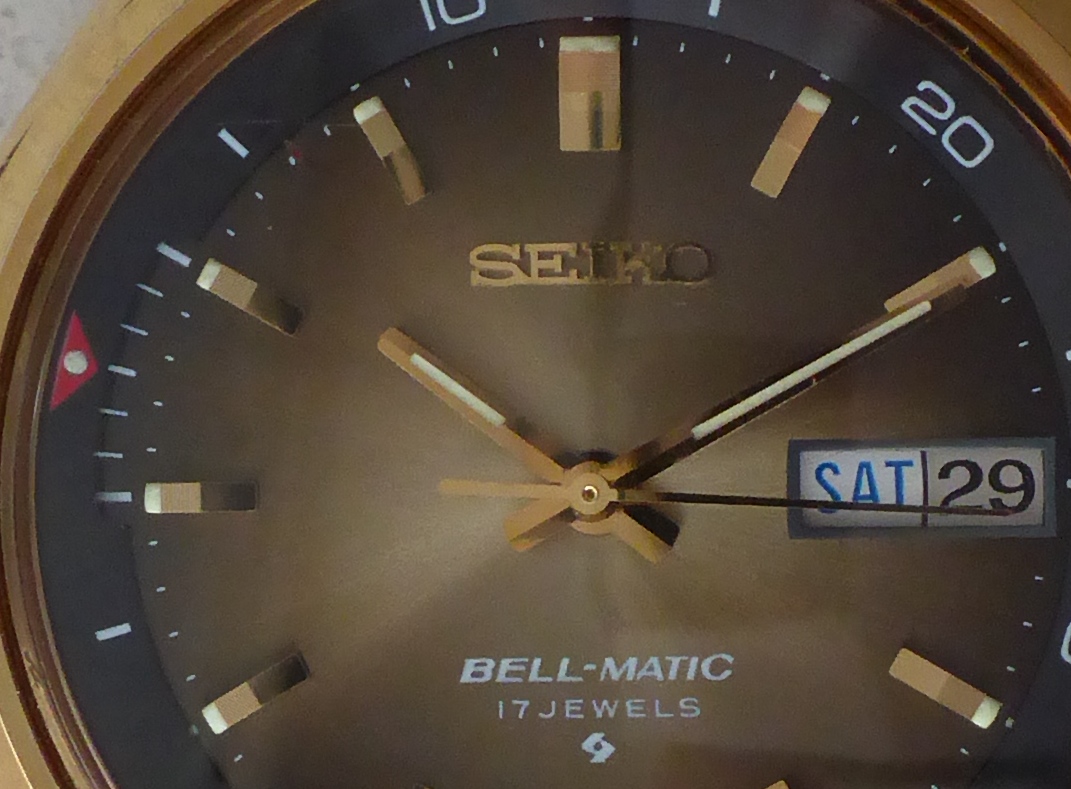
Unlike the chronographs that had one, two or three sub dials, the Bell-Matic was not very distinctive; the alarm indicator is on the rotating ring around the dial and doesn’t stand out much. The only real distinguishing feature is the extra button at 2 o’clock. This sets the alarm on when out and doubles as a quick set for the date when depressed.

Like most Seikos of the period the Bell-matic is self winding with no auxiliary hand winding. But there are two springs, the mainspring for the watch and an alarm spring for the alarm. The alarm spring is wound manually with the main crown.

The 4006 is a tough reliable movement that was produced from about 1966 until around 1978 when about the only competition left was the emerging digitals which incorporated an alarm alongside a multitude of functions.

This gold plated example is all original and in near mint condition. The dial is iridescent brown with a striking sunburst affect that I couldn’t photograph. The bracelet, also original, with a three fold clasp that is signed.

While in production, Bell-Matics were at the high of the commercial end of the market, (if that makes sense) I have a 1977 Seiko catalogue and this watch is listed and they where about 25% more expensive than the Seiko divers “turtle” and about three times as much as a basic Seiko 5 automatic. Today only good examples are of interest but they are nowhere near the Seiko chronographs in popularity.

Posted in Seiko | Tagged , , , , , , , , | Leave a comment

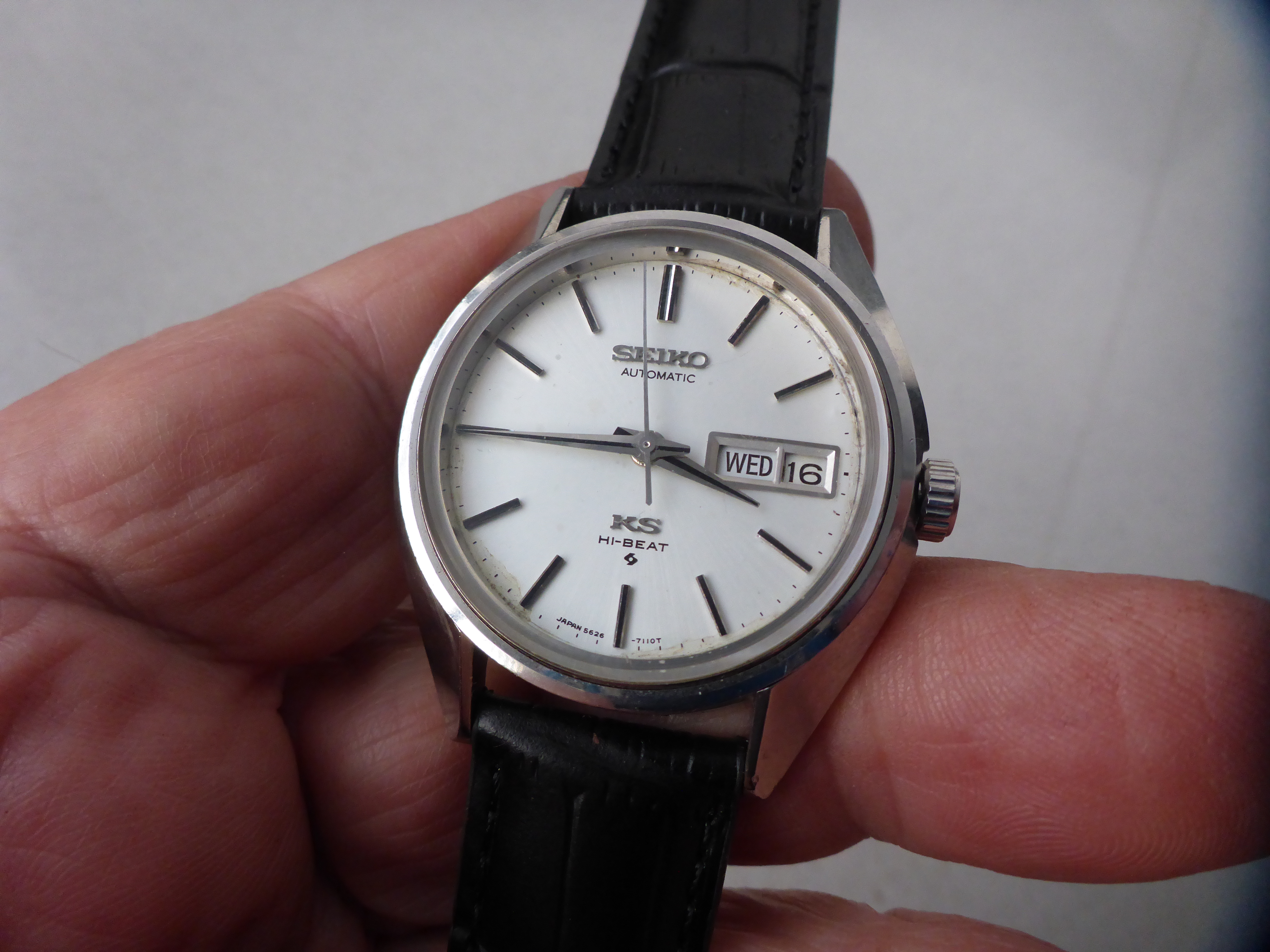
KS Seiko 1971

The “KS” stands for King Seiko which was second only to the GS or Grand Seiko at the top of the line Seiko of the 60’s and 70’s. It is a quality, conservitive in style, high tech, all rounder, aimed at the professional who could wear it anywere from the office or formal function, to the boat and on the tennis court. Don’t forget that we are in an era when hardly anyone had more than one watch.

Among its many features is a monocoque case (no case back) meaning only the crown and the glass are possible entry points for moisture. Another is a hardlex crystal, many times harder than perspex which was the standard at the time.

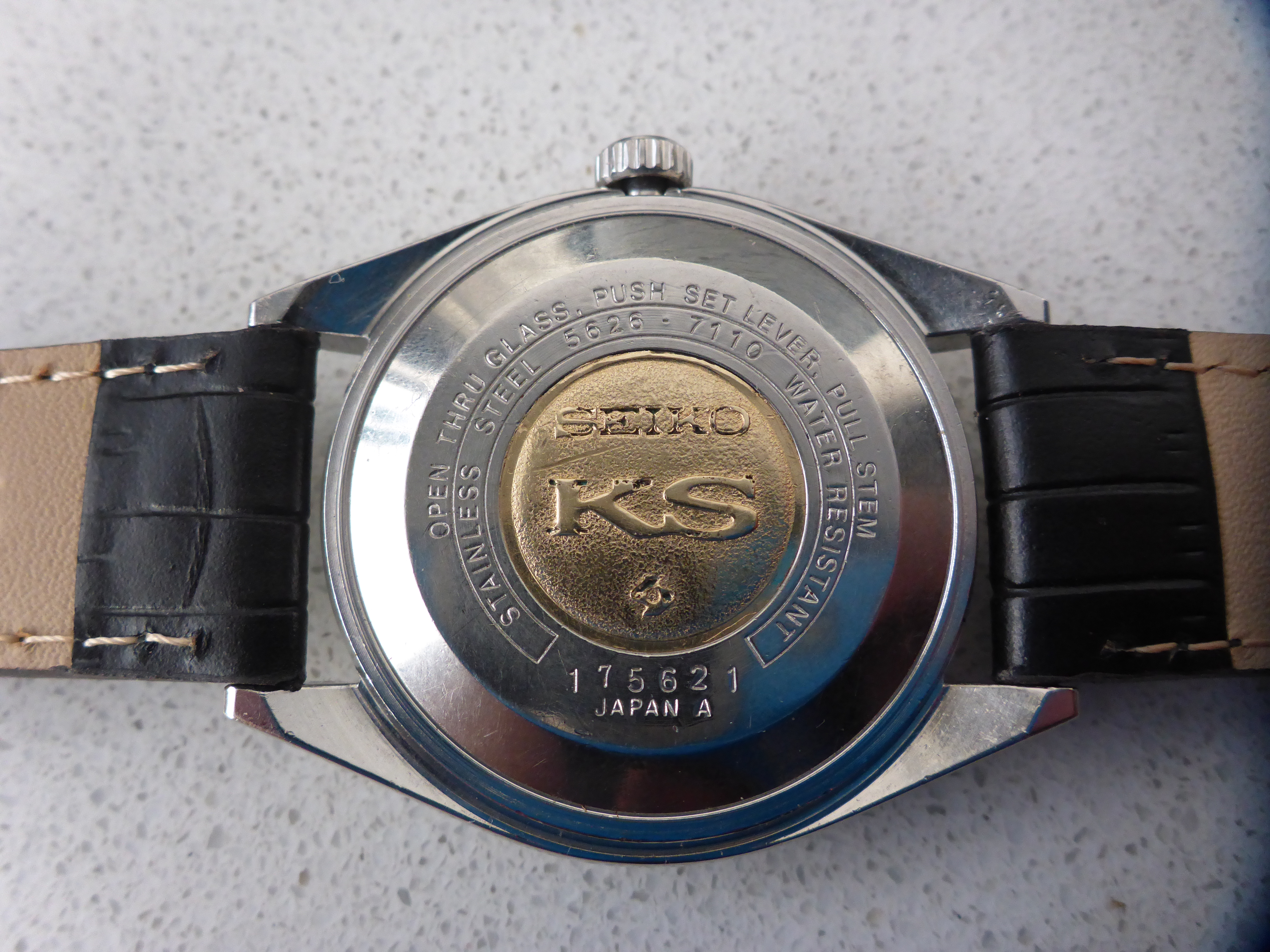
The  movement is the 5626, the high beat version of the 5606 which was Seiko’s basic flagship movement from 1968 to the late 70s. It is very sophisticated and refined. At 4.45 mm thick, it was the thinnest automatic movement available when it was introduced. It is potentially very accurate because of its high beat rate (beating at 28,800 beats per hour) whereas the 5606 and just about all other movements were ticking away at 21,600 beats per hour. It also has auxiliary hand winding and hacking.

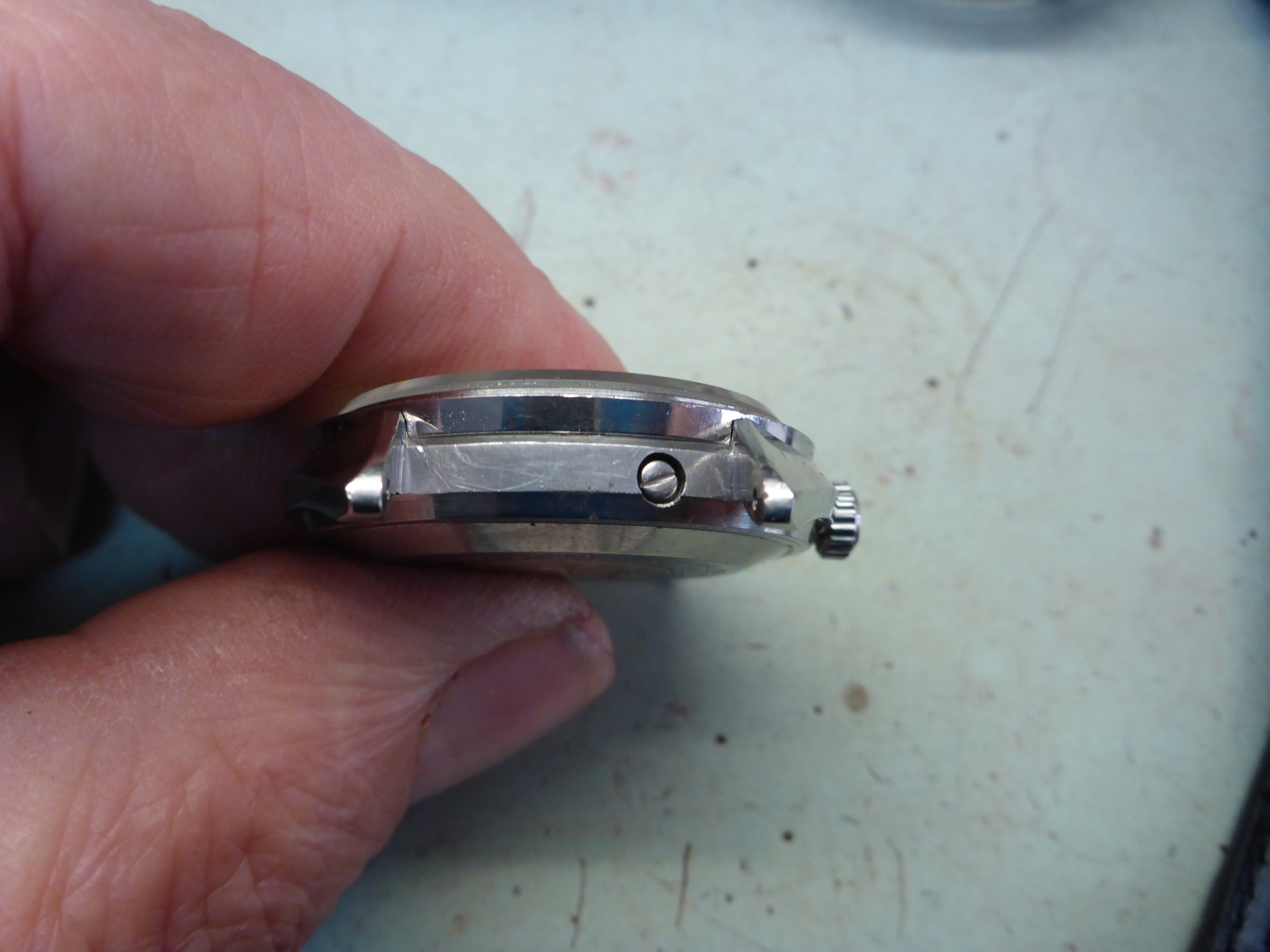
A unique (to me) feature; A screw plug that when removed allows accuracy adjustment.

But this watch has a feature that I have never come across previously, the ability to calibrate the timing without opening the watch. And, being a one piece case, getting to the movement requires more than just the appropriate tools; it also requires know how and the skill of an experienced watchmaker. So, the owner can calibrate the watch themselves by removing the screw plug situated between the lugs at six. Inside, there is another screw which can be turned, very slightly, to adjust the timing of the watch. 

It’s not a very distinctive watch. Aesthetically, there’s really not a lot separating it from lesser models like the Lord Matic. But it does have a certain simplistic quality look to it. When turned over it’s a different story, the gold “KS” medallion is impressive and leaves us in no doubt that this is a special timepiece. Oh! I almost forgot. Seiko have at last signed the crown “KS”

Posted in Seiko | Tagged , , , , | Leave a comment

Cyma Navy Star c1950

Cyma was founded in 1862 in the town of Tavannes, near Bern, Switzerland. It has always been a luxury brand that produced almost every component in house.  In 1945 they started to produce an amazingly good alarm clock, the R10 which became recognised as the best alarm clock available and stayed in production until the late 60s. During the 50s to the mid-60s, Cyma wristwatches were among the most popular prestige brand in my part of the world, they were no nonsense, quality and beautiful.

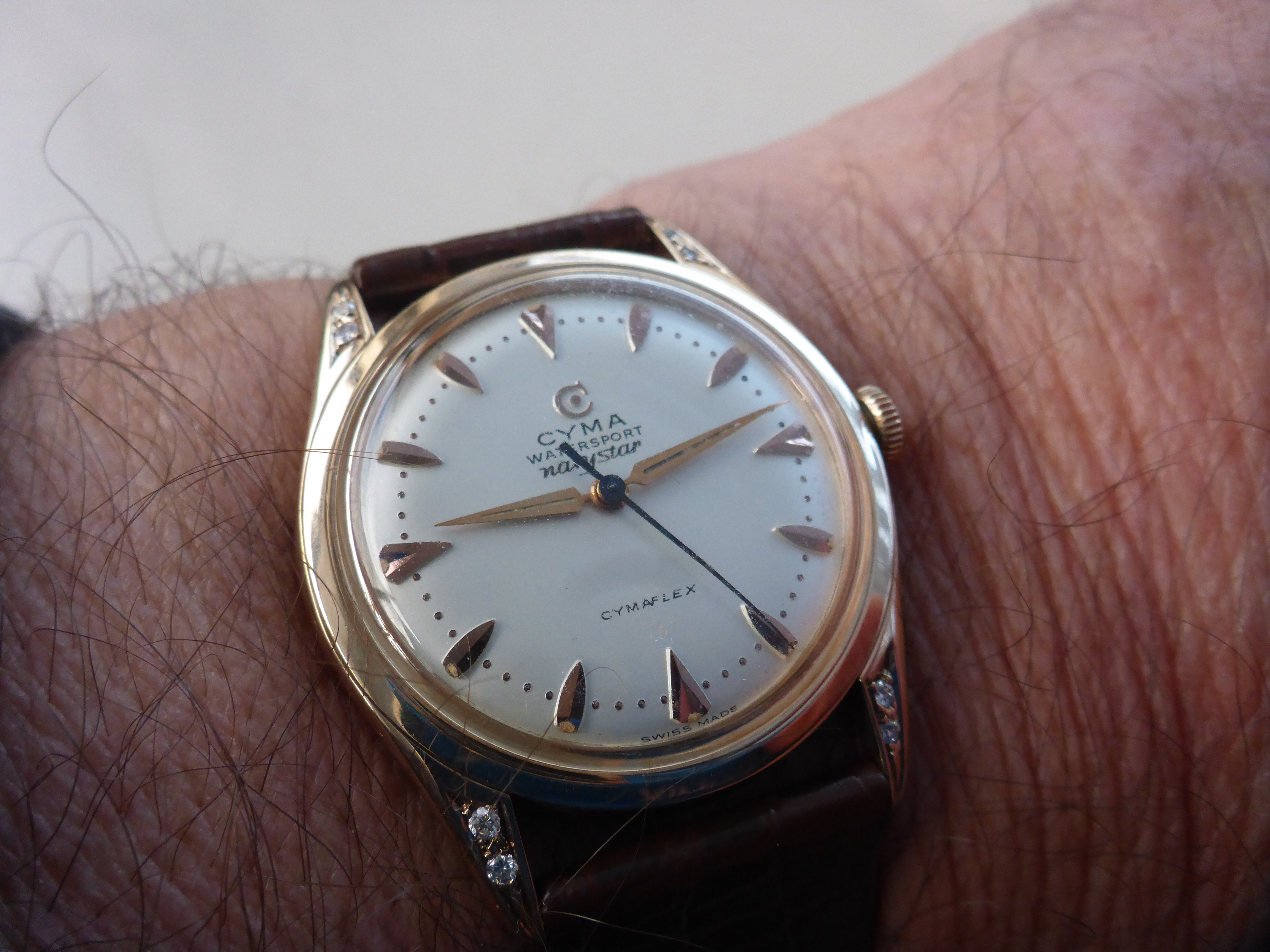
Note the two diamonds set in each lug.

Cyma’s styles have always been conservative and the technology seemed to never been at the cutting edge. But they were well constructed and no nonsense beautiful.  This Navystar from the early 50s is no exception. The case is solid 9ct gold with the diamonds bead set in each lug. I have never seen this before in any watch and I tend to think that this is a modification. There are also two diamonds set the 9ct gold buckle, also new to me.  The dial features superbly polished index markers and raised “C” logo. The hands are lancette style with a very fine strip of luminescence while the sweep hand is blue oxidised steel making for a pleasant contrast.

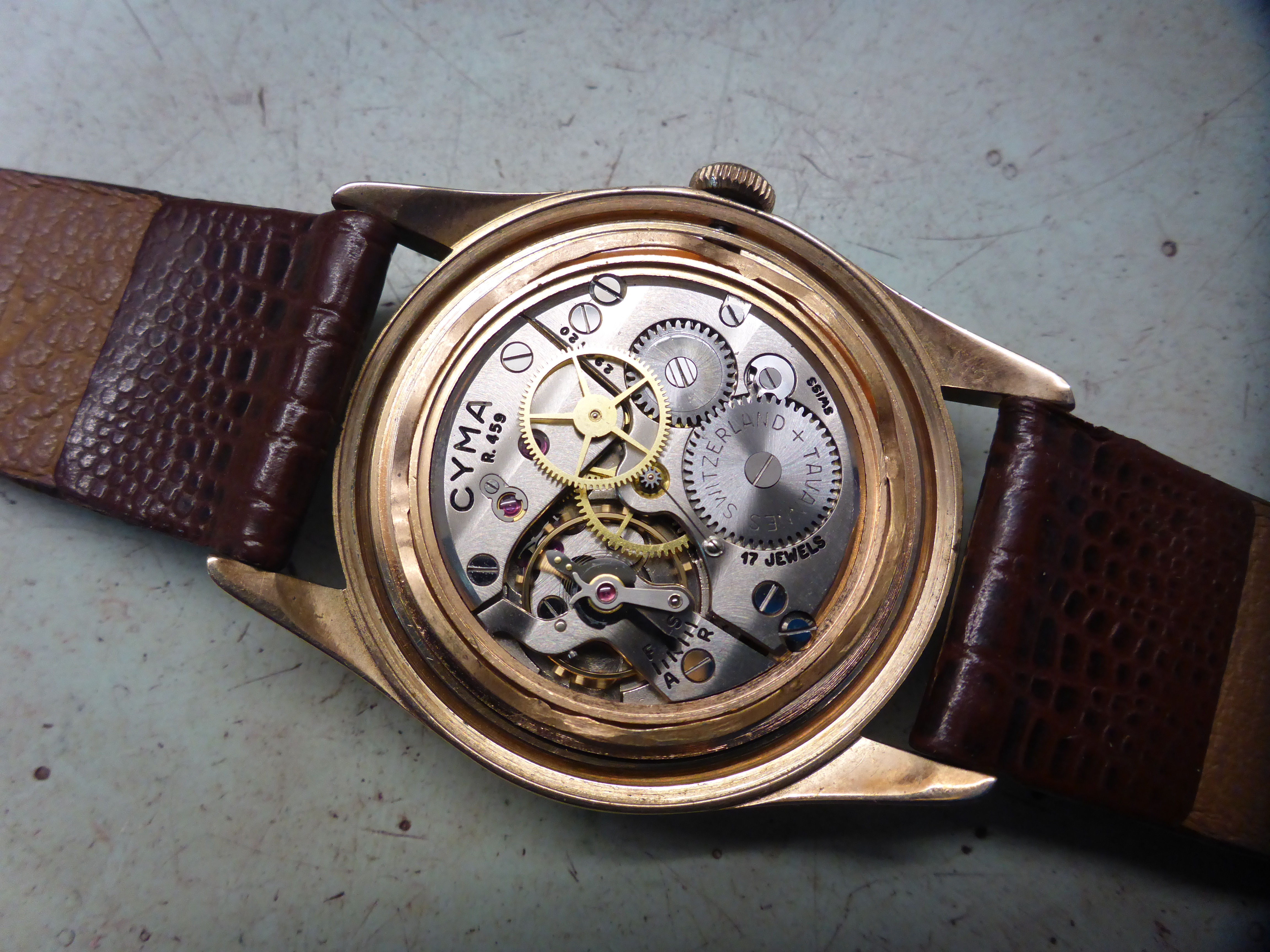
Technically, the in house R459 manual wind movement is well finished in the Swiss tradition of the time. It features Cyma’s own Cymaflex shock proof system. The sweep second hand is indirectly driven by an extra wheel as can be seen in the picture.

This watch came to me in a bundle of classics from a deceased watchmaker. I probably would not have bought it if it was presented to me individualy. But when I inspected it closely, I soon fell in love. It is in near mint condition and all the preportions are beautifull. It had to take its place in my collection.

Posted in 9ct Gold, Cyma | Tagged , , , , , | Leave a comment

Seiko Lord Marvel, 1967

A pure Experiment

The accuracy of a watch depends on many factors; one of those is beat rate, which is the frequency at which the balance wheel oscillates. Or, put more simply, the faster it ticks, the more accurate it potentially is.  For over a century, virtually all mechanical watch movements performed at a steady 18000 beats per hour (2.5 hertz). In the early 60s, manufacturers started to increase the bph slightly to 19800 or even 21600 (3 hertz). 21600 bph soon became the standard and remains so to this day.

But, there were forays into the high tech area of 28800 (4 hertz) and finally, in 1966, Girard Perregaux broke through to the 5 hertz mark (36000 bph) in developing the automatic 32A movement.

Seiko answered the Swiss achievement a year later, in 1967 with this, – the 5740C manual wind movement.

The Girard Perregaux effort was a an upgrade of the generic, manual wind AS 1687/1688, made automatic by the joint effort of watch companies Doxa, Eberhard, Favre-Leuba, Girard-Perregaux and Zodiac. Whereas the Seiko 5740C was developed completely in house by Seiko.

So here we have the Lord Marvel 36000. So unpretentious in its un Seiko absence of features, not even a date! And, on a leather strap! Maybe Seiko wanted to market the fact that it was one of only two watches that beat at such a furious rate and, therefore, able to be adjusted to run very accurately. The precise accuracy was never specified but I know from experience that high beat movements, in good condition and recently serviced, can be adjusted to vary less than +/-5 seconds a day.

There is a very subtle elegance to the style. It’s not big, just 35mm case. The dial, hands and markers are superbly finished to a standard that Seiko was to become renown for. The case is a little bulky, very robust with a large crown for easy winding. The lugs are long to accommodate a leather strap, there was no metal option.

It sold in Japan for   ¥14,000. That was about AU$165. At the time, the average wage in Australia was $57 per week. So, who would spend almost three times the average wage on a watch that was very basic and Japanese? This watch had no features apart from its accuracy and was more costly than a prestigious Swiss watch. Needless to say, it failed in the marketplace. But after all, this watch was the 36000bph experiment in its purest form. Once Seiko knew the 5740C was a technical success, they were able to market the hi-beat 36K Grand Seiko line.

Posted in Hi Beat Movement, Seiko | Tagged , , , , , | 2 Comments

Seiko 5 Sportsmatic 1966

The Springboard to success

In the early 60s Japanese products were a rarity in the western world. It was less than two decades since the end of the war, there was a prejudice that went with the war memories and it was generally believed that the Japanese were only good at copying western technology, do it cheaper and were inferior. 

In the early sixties Seiko wanted to break into the western market and to do this they needed an affordable watch that was versatile and durable. An everyday device that could handle a wide variety of different situations and environments. So was born the ‘5‘ concept.

The ‘5’ came from the 5 features they wanted to incorporate into the watch.

These were:

1. Automatic winding
2. Day/date display
3. Water resistance
4. Recessed crown
5. Integrated metal bracelet

In 1963 the first ‘5’ was released, became an immediate success and has gone on to become the most successful line of mechanical watches in history.

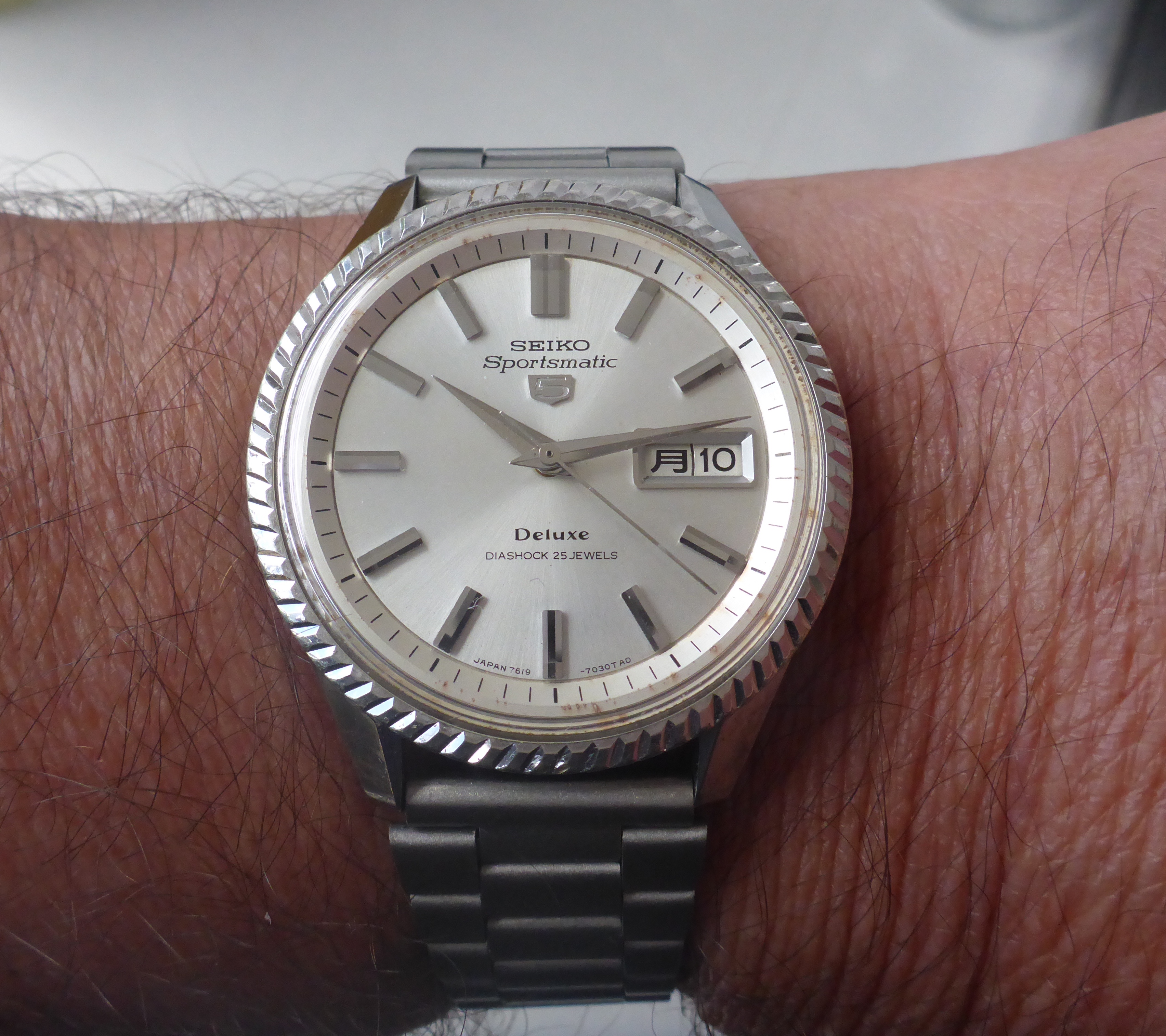
This is a 1966 Seiko 5 Sportsmatic. A beautiful dial with exceptional polish on the index markers, the date window, “5” logo and hands. Quite unusual for Seiko is the corrugated bezel making it rather distinctive.

Now, of the 5 features mentioned, a recessed crown doesn’t seem too radical but if you look at this watch, it appears quite “clean” in style. I think that a big part of that is the fact that the crown is not visible.

Additional features of this watch are; hacking mechanism (stopping the watch when the crown is in the time set position allowing for precise setting of the time) and a quick date change feature. This is operated by another button in the 10 position, also recessed. This button operates the quick change for the date when pressed.

I believe that this watch was only released onto the Japanese domestic market. In support of this thought, I could only find one ad and that was in Japanese. Also, the day display is only in Japanese, not bi-lingual as was the case with watches marketerd in the West.

The ad suggests the price was ¥11,000, that’s about AU$130. The average Australian wage at the time was $57 per week. So at more than double the average weekly wage, this was an expensive watch, almost $2,500 in today’s value.

This is an exceptional example of an important watch in horological history, a good looking automatic watch with day and date, hacking and quick date change were stand out features that were rare in even the best Swiss watches of the day. It played a big part in making Seiko the even greater watchmaker that it was soon to become.

Posted in Seiko | Tagged , , , , | Leave a comment

Seiko 9ct Gold Dress Watch, 1990

Simply Beautiful

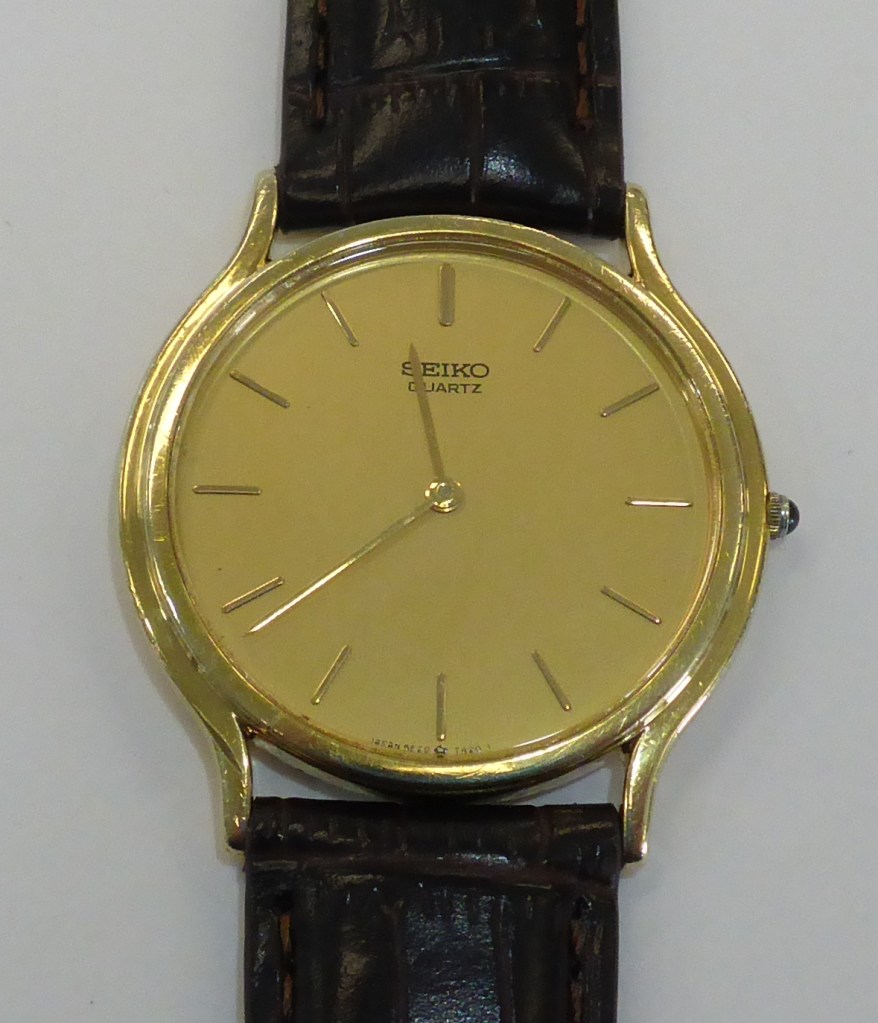
This is as simple and as beautiful as it gets. It tells the time and that’s it. No date, no second hand. Just two, highly polished, pencil style hands indicating the hour and minutes. This watch is all gold in colour. There is very little contrast on the dial. Gold finish with simple, highly polished, raised index markers that match the hands perfectly. Only “SEIKO QUARTZ” is printed on the dial….that’s it.

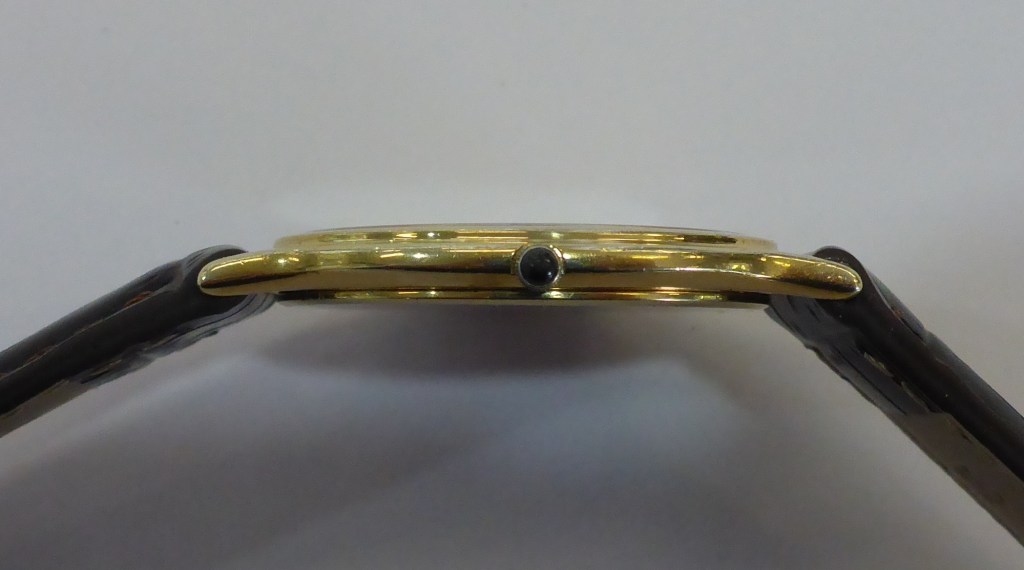
The case has two stand out features: firstly, 9ct solid gold, very rare in a Seiko. And secondly, wafer thin, only 4.5mm thick with a flat hardlex crystal glass. It has a classic shape with fine lugs that curve into the case integrating perfectly. A nice touch is the sapphire set into the crown, following the Swiss tradition of dress watches.

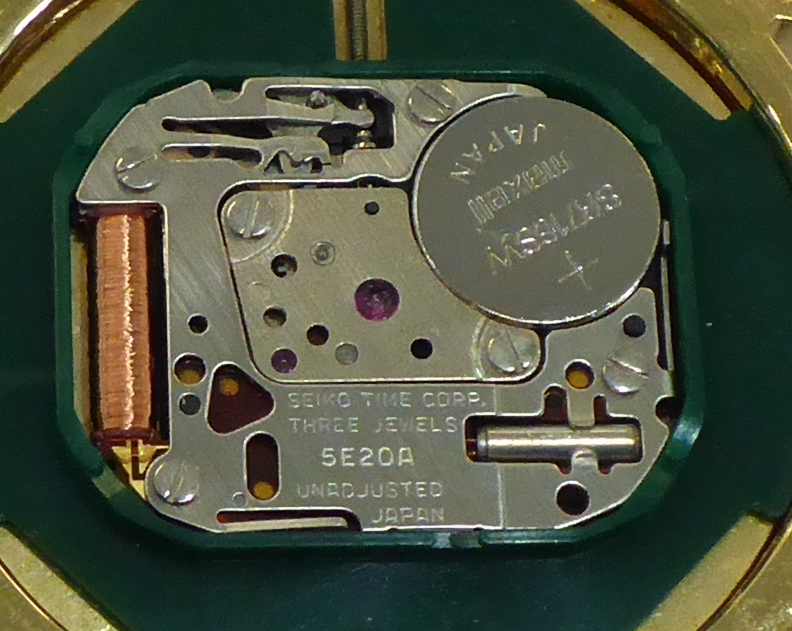
The movement is the rare 5E20A, the nicest Seiko quartz that I know of, jeweled and finished like the Seiko mechanicals of old. I love seeing my eyeglass in the mirror like finish of the screw heads! The modern mechanicals with exhibition backs don’t have the same standard of finish. Sometime between this model (1990) and now, Seiko has lost the art of fine finishing movements.

This watch is personal. It sits on the wrist so nicely that it is unnoticeable. It becomes part of the body.

Posted in 9ct Gold, Seiko | Tagged , , , | Leave a comment

Seiko Prospex Diver

The “Turtle”

Seiko dive watches have a huge reputation. They’re as tough-as, look the part, have a heritage as long and proud as almost any brand and are very wallet friendly.

As a collector, I have never been a huge fan of divers’ watches, there’s not much distinction about them mainly because the criteria required leaves little room for style variations.  There are only three dive watches I can identify with confidence from a distance; the Rolex Submariner, the Omega Planet Ocean and this one; the Seiko “Turtle”.

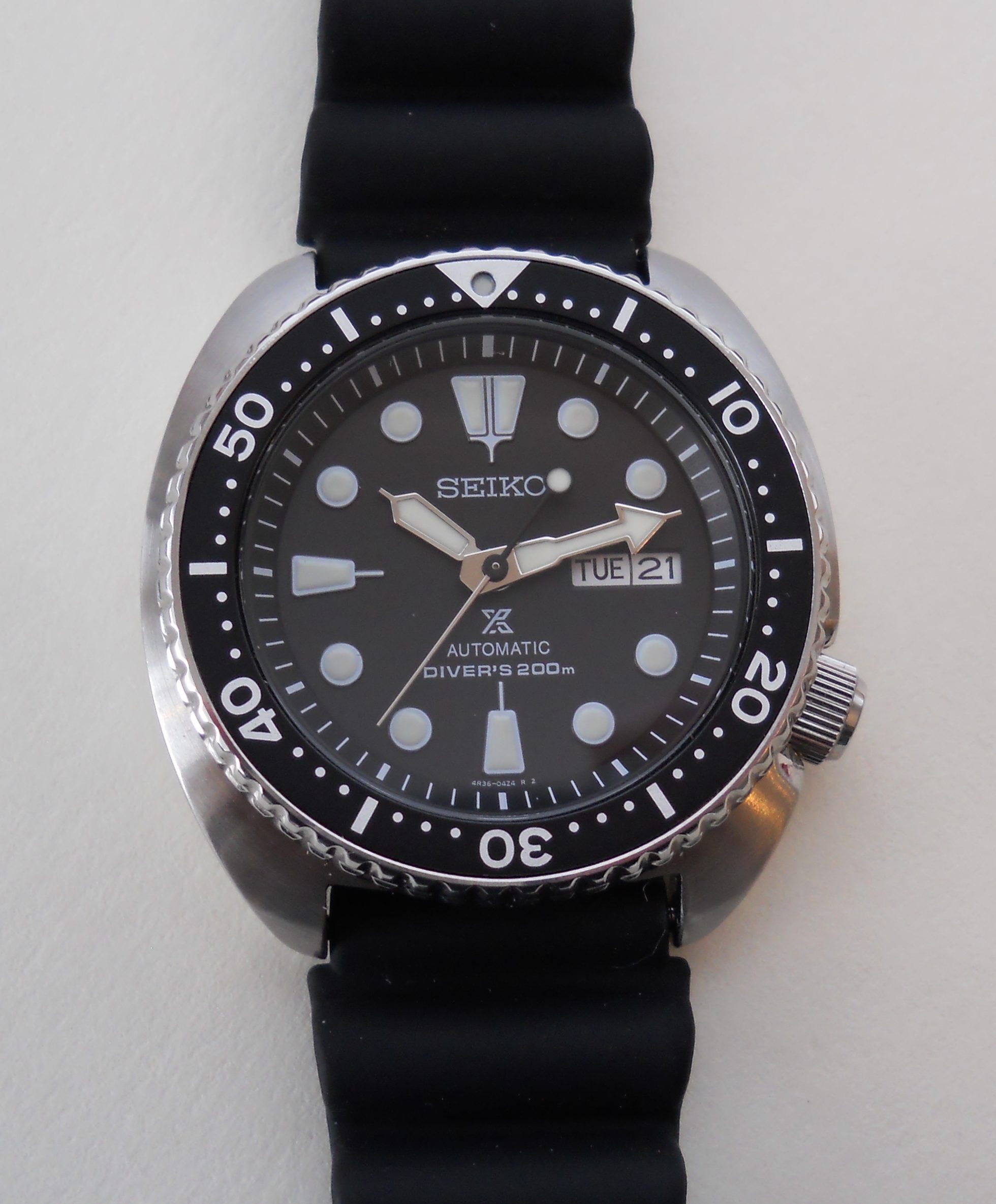
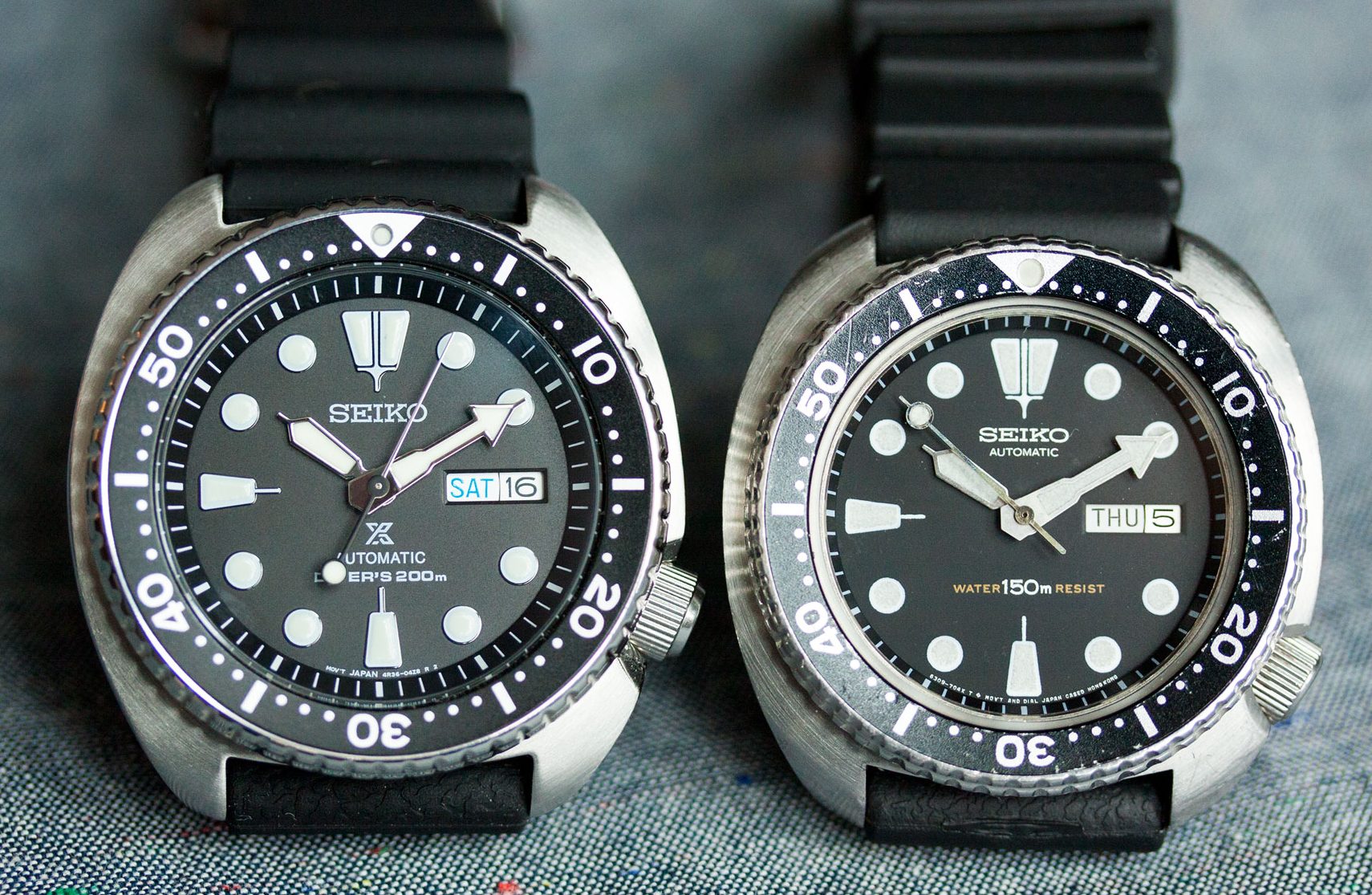
Prospex “Turtle”, left; original 1976 “Turtle”, right

In 1976 Seiko released its new diver that featured a 150m case, screw down crown and unidirectional bezel with double row of polished grips. The dial had large, round index markers with very generous luminous material. The 12 marker has a subtle sword that matches well with the lines coming out of the 9 and 6 markers.  But the most distinctive feature was its subtly different case shape that made the “Turtle” stand out. Broad and cushion-shaped it inspired the watch’s nickname, because if you look at it from a distance and used a little imagination it resembles the shell of a turtle. The original was in continuous production for about twelve years.

Having described the original turtle in some detail, a ditto will suffice to describe this re-release with the following updates:
The new 4R36 movement can be hand wound and has a hacking function*. Both features lacking in the original.
Water resistance is rated at 200m, the original was 150m.
The luminous “lollipop” on the original second hand has been moved to the counterweight.
The strap has a beautiful, heavy, strong looking buckle. It also has a beautiful stainless steel keeper. Both buckle and keeper are signed “SEIKO”.

One criticism that I have of this watch is the action of the bezel. Like the big Swiss brands it’s a 120 click to one rotation and is rather firm. But it lacks a certain profound click and accuracy when compared to the Rolex Submariner or the Omega Planet Ocean.  But then, this watch costs a fraction of these elite brands.

The Seiko “Turtle” is faithful to its heritage, looks great and, without doubt, the best value divers’ watch on the market.

*Hacking means the watch is stopped when the crown is in the hand set position. This allows for accurate time setting


Posted in Divers Watch, Seiko | Tagged , , , , | Leave a comment

Omega Digital 1978


Panic in an uncertain future

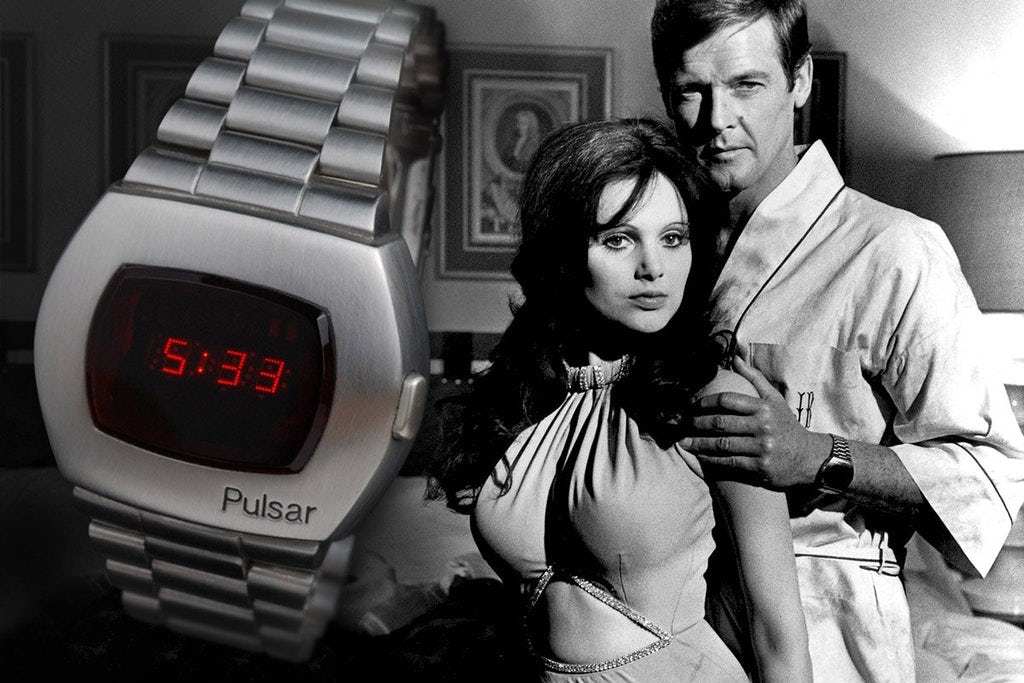
In the middle seventies, the traditional Swiss watchmakers saw their one hundred or so years of dominance threatened by quartz technology that came in two forms and from two directions, analogue from Japan and digital from the USA.

Seiko was first with the analogue Astron, launched in the last 6 days of the seventh decade of the 20th century(25th December 1969). The Hamilton Watch Company released the first LED digital in 1972. Both these releases where available for about the price of a small car. Prices soon began to tumble, but the shortcomings of the LED meant that the LCD (Liquid crystal display)  took control and several serious watchmakers, not knowing where this new technology was headed, decided to play safe and follow what seemed to be the trend.

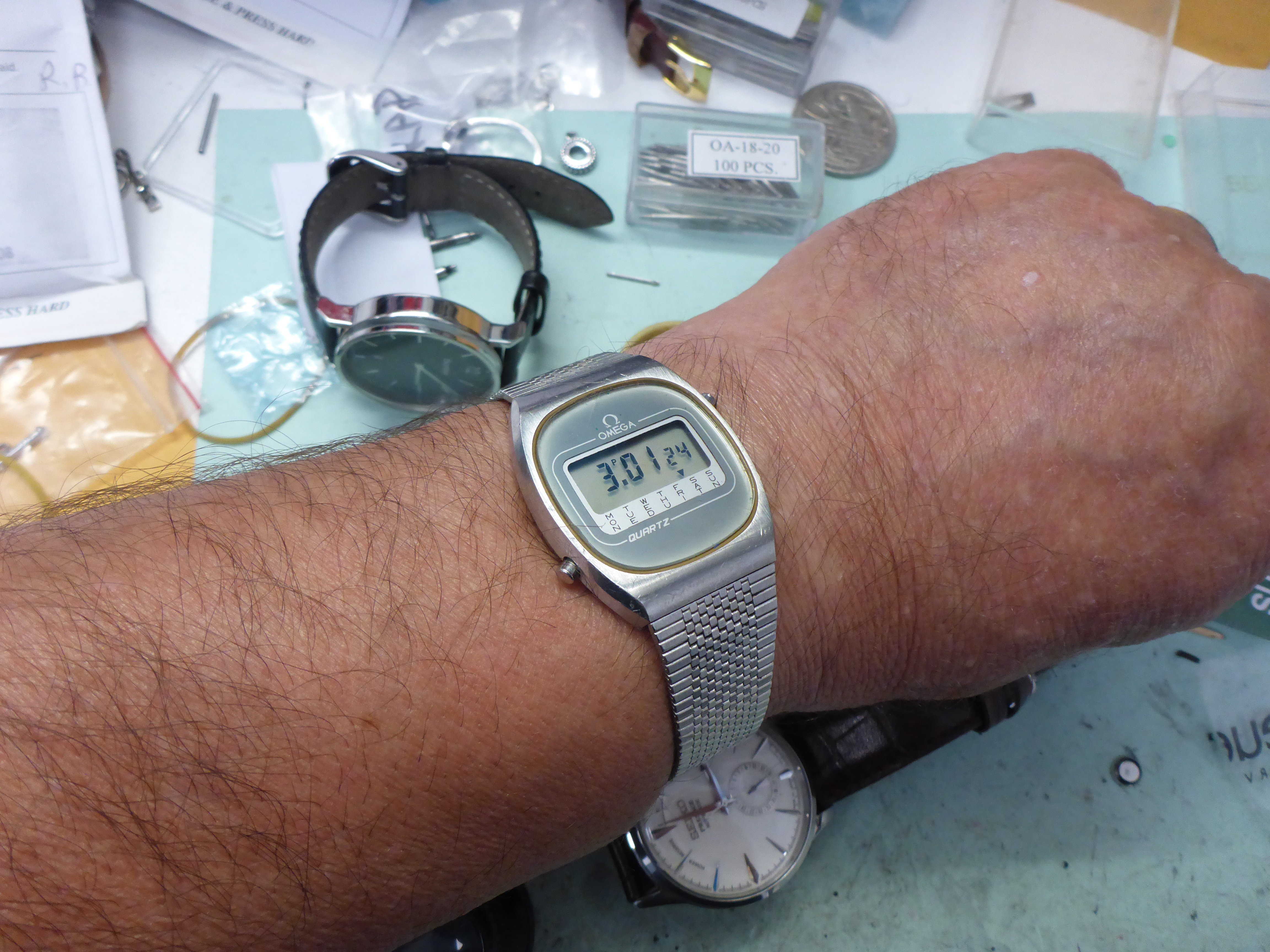
This example, from 1978 is quite basic. Omega trumpeted that the “Omega Quartz Digital: Style, precision, reliability” I agree with the latter two comments, but I don’t agree that it contributes much to style. It was also quite basic, having only day and date function, in addition the full time display, and a light to illuminate the screen.

Omega also claimed that the Omega Quartz Digital “is one of the most technologically advanced watches in the world”. I also disagree with this claim. In 1978, Seiko, and others, already had more advanced digitals with features such as chronograph, alarm, countdown functions as well as being programmed for leap years.

Let us have no doubt that quartz digital technology was a giant leap forward. Quartz was to mechanical watches what light bulbs were to candles. It’s not surprising that Omega executives thought that the digital was to be embraced for the future. Facts were, quartz digital technology offered stunning and unprecedented accuracy, reliability, had no moving parts, it can feature a multitude of functions and it was cutting edge technology.  It was a logical business decision to go in that direction.

They were wrong! Over the next few years, LCD prices dropped and the digital watch cheapened in both price and image. By the mid-eighties just about every big watchmaker had dropped all digitals from their respective ranges.

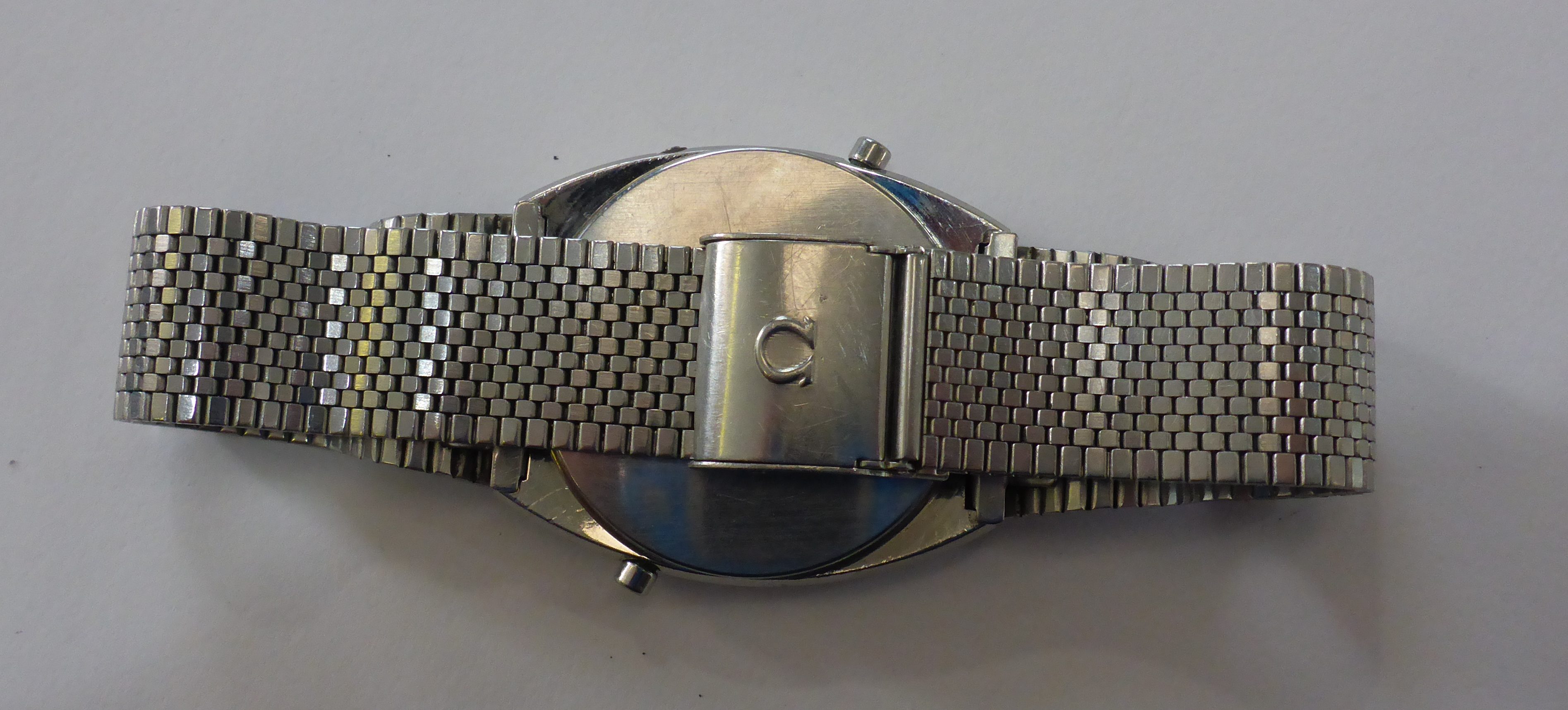
Back to this watch; while most digitals focused on the sports watch market, this one is more on the dressy side. Being only 8mm thick it sits very nicely on the wrist and has a fine stainless steel mesh bracelet. It is water resistant to 30m and has only three buttons. It is signed four times; dial, module, inside the back and the clasp. Missing is a medallion on the case back as you would find on almost all Omegas of era, this back is completely plain.

Roger Moore as James Bond wore a Pulsar Digital in Live and Let Die, 1973

This Omega Digital watch is an important icon in horological history.


Posted in Digital, Omega | Tagged , , , , | Leave a comment