Minerva Pocket Chronograph

?????????? ??????????

This interesting and rare timepiece is a Minerva pocket chronograph from around 1920. I had a lot of trouble identifying it because it’s unsigned anywhere but I’m pretty certain that it is a Minerva 9 or 10.

It’s a single button chronograph operated by a pusher in the centre of the winding crown.  It is a simple, start; stop and reset with a 60 second register and a sub dial 30 minute register.  At about 50mm in diameter, it’s a standard size pocket watch.

From the front, this watch is beautiful with its two sub dials and fine hands. But it’s the dial that is exceptional. Enamel with classy roman numerals, each sub dial is clearly marked and chapter markings down to one fifth of a second, for accurate reading.

Now, Minerva made classy chronographs in Gold or Sterling Silver. This watch is made of gun metal, the tough alternative to the precious metals. On the technical side, the watch has a flat hairspring whereas an overhanging Brequet hairspring (more expensive) was the Minerva norm. This watch was made to be used practically more than for a prestigious show piece. Its market was the horse trainer or the sporting coach so, in this more standard model,  Minerva kept their name off the dial and even the movement.

This is a special watch to me for several reasons. It is the first watch I collected, before I actually started collecting.  Back in the early 70’s my soon to be mother-in-law showed it to me, knowing nothing about it or where it came from. When I showed interest, she gave it to me. I put it away and forgot about it until recently.
Posted in Chronograph, Minerva, Pocket Watch | Tagged , , , | Leave a comment

Seiko Navigator 1972

?????????? ??????????

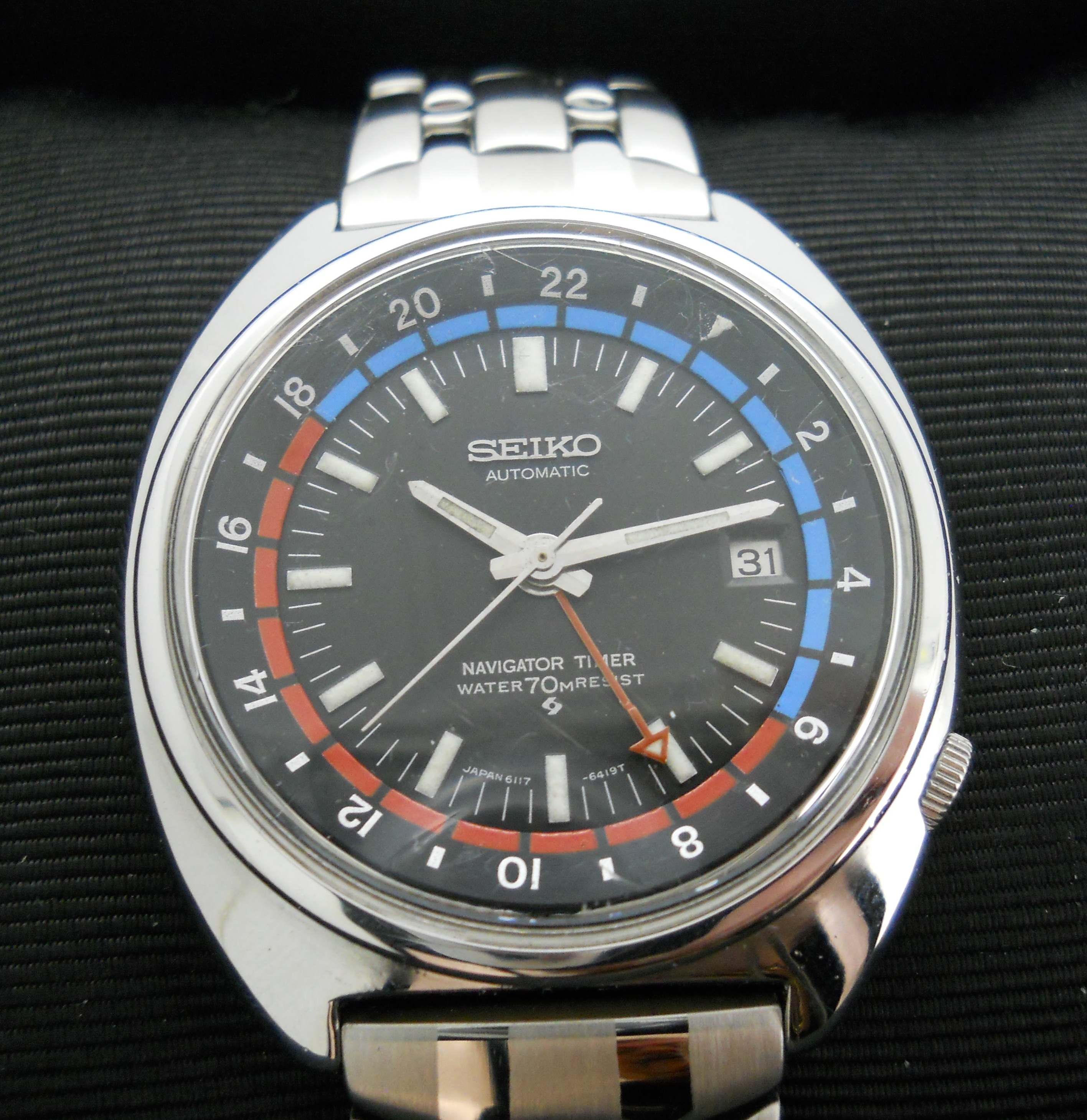
With great looking designs like this, ultra reliable technology and a reasonable price tag it’s no wonder that Seiko took a strangle hold on the market during the 70’s and 80’s.

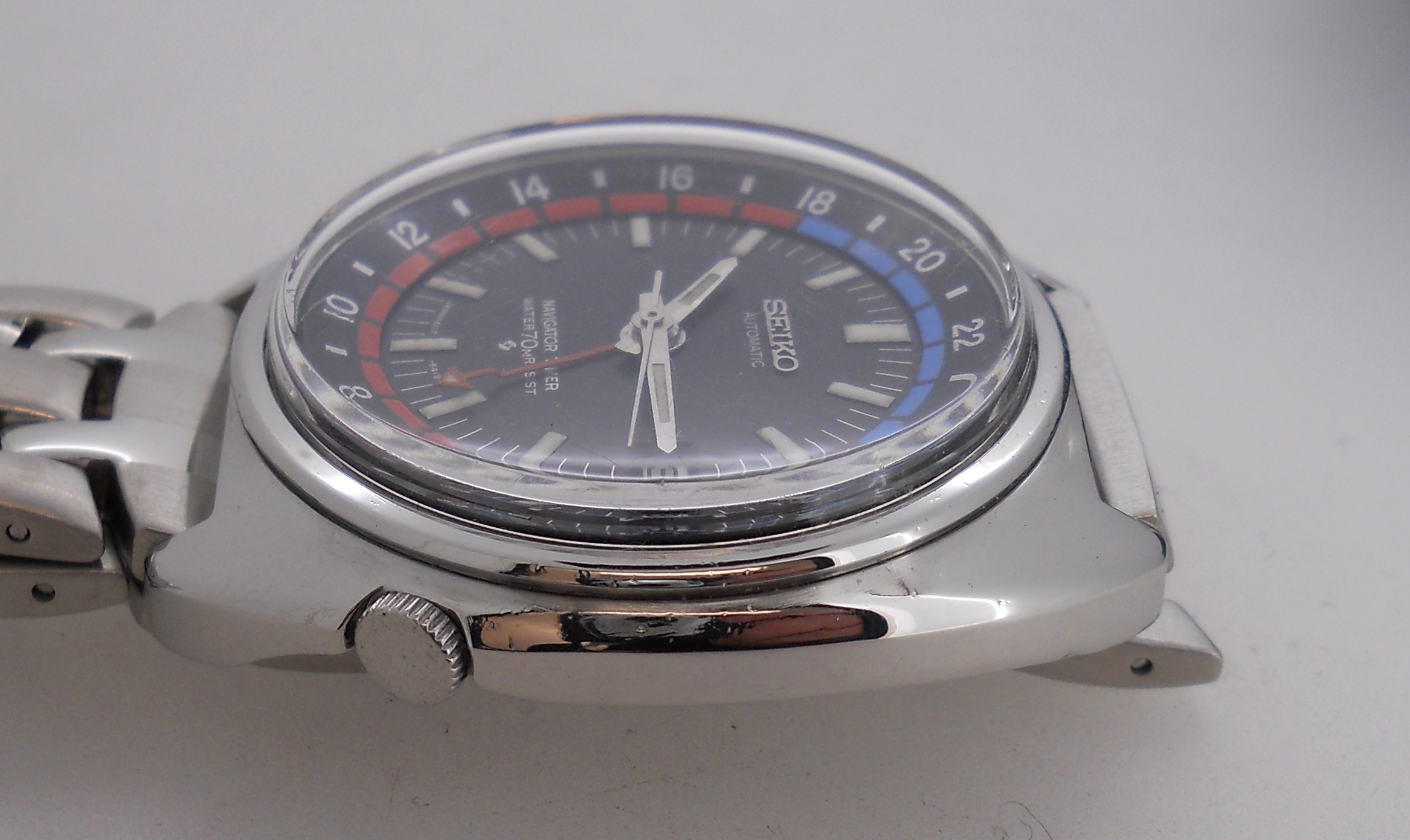
The Seiko navigator from 1972 featured a 24 hour GMT hand an internal (under the glass) rotating bezel, operated by the crown and hacking. Hacking means that the watch is stopped when crown is in the hand set position allowing for easy synchronisation. This rare feature is usually found in very accurate timepieces such as chronometers.

Called the navigator because by setting the 24 hand to GMT, and adjusting the main hands to local time, longitude can be calculated by noting the time differential. This system was only possible when an accurate, sea going chronometer was developed by John Harrison in mid 1720s. Captain Cook used this system which enabled him to create superbly accurate charts of his voyages. I doubt if any owner of this Seiko Navigator used it for serious navigation but, Seiko were brilliant in creating a sexy image such as this for their products.

With its already mentioned features, the red and black trimmed bezel on a black dial with white index markers, this watch looked practical, modern, tough and generally fantastic and it hit the mark in the market place.

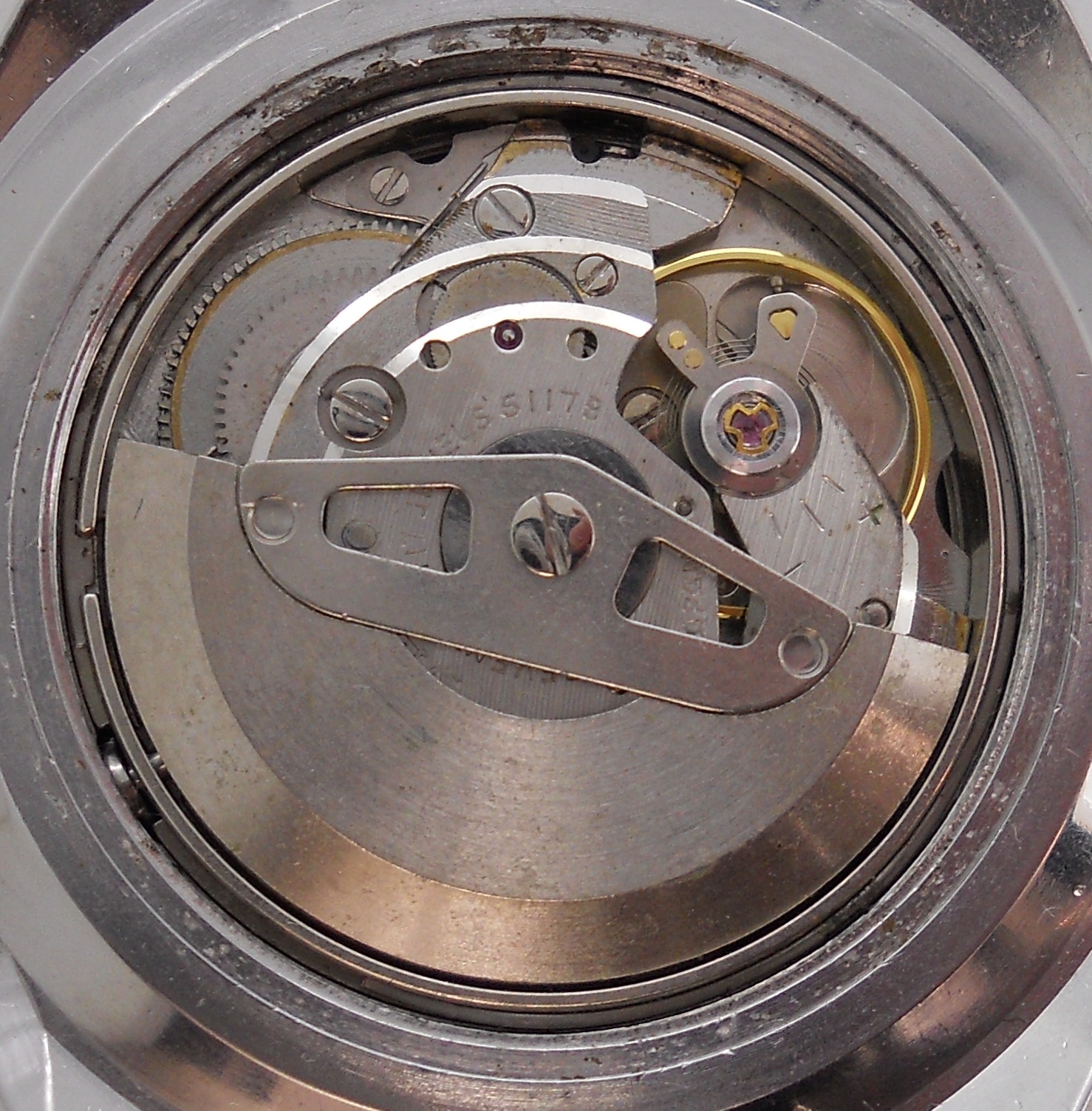
??????????The 6117B movement is a complication of the standard 6119 that was the backbone of the brand and did much to establish Seiko’s reputation. With its sophisticated ex-center self-winding mechanism with just one gear stage, this movement was so simple that the conservative watch trade could not take it seriously. But it soon proved to be as strong, accurate, reliable and durable as Swiss counterparts many times its price.

This timepiece came to me in poor condition but complete except for the bracelet. I overhauled the movement, restored the case and polished the glass. I am very happy with the result.

Posted in Seiko | Tagged , , , , , , | Leave a comment

A Box of Seiko Chronographs

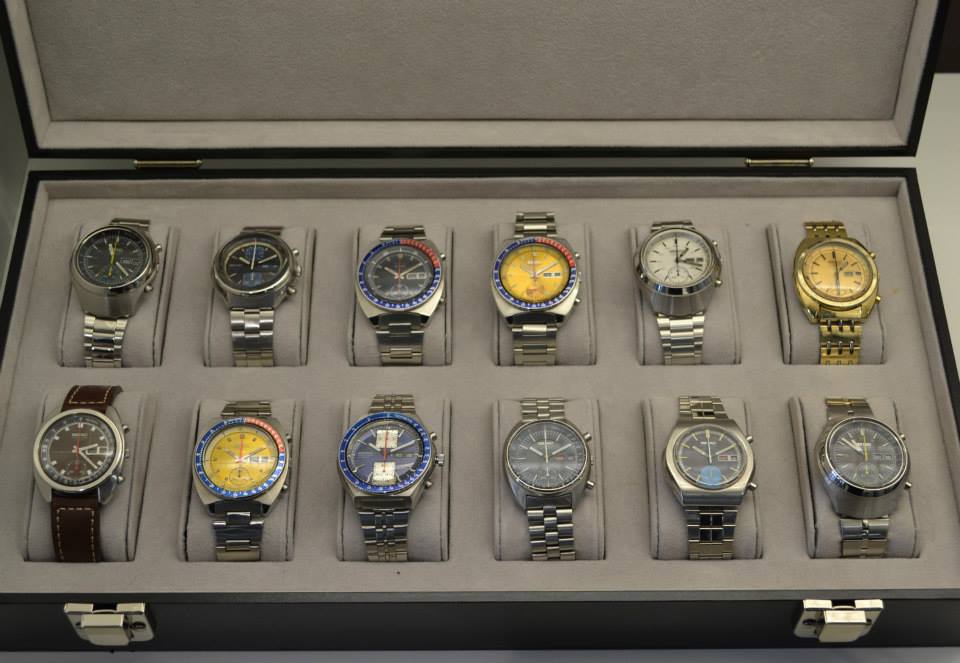
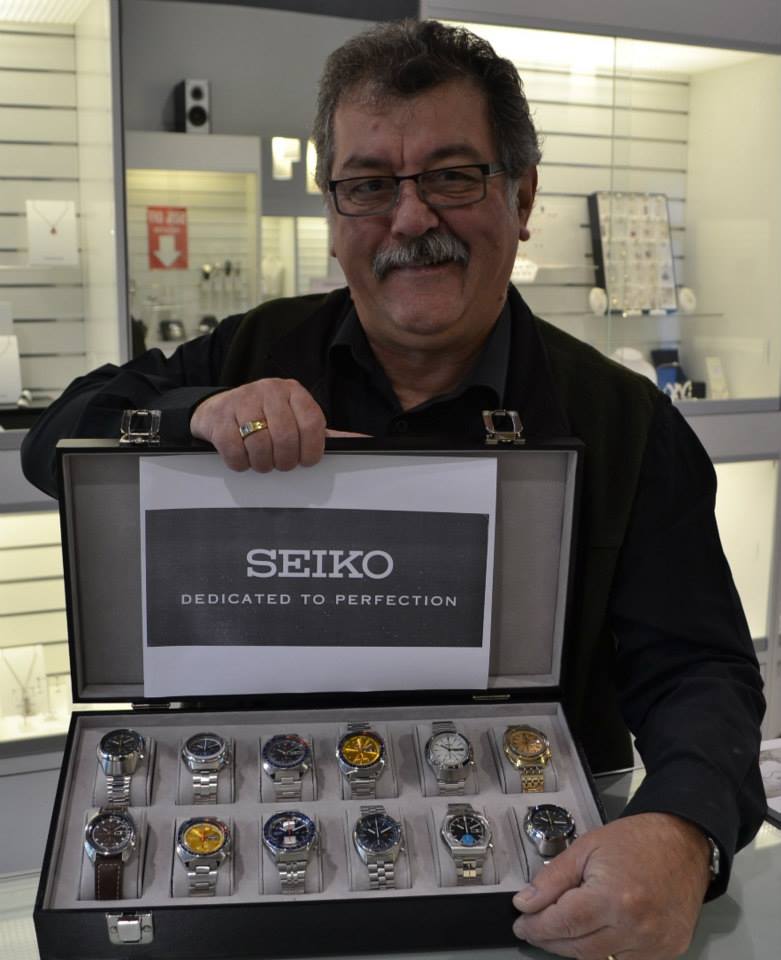
531901_10151516670601652_144980870_nMy collection of Seiko mechanical chronographs. Twelve of them, all restored and working well. Some of the bracelets are  non original but all else is authentic. They were produced from 1969 until 1979. Two movement types are represented here; the 3 register, 2 sub dial 6138 and the more basic 2 register 6139 with only one sub dial’.

There is dispute about who produced the first automatic (self wind) chronograph, but of the three contenders I think it was the Seiko that hit the market first in 1969 and blitzed the others in the marketplace.

602097_10151516670606652_97082995_n

Love my Seiko Chronographs


Posted in Chronograph, Seiko | Tagged , , , , , , , , , | 1 Comment

Longines 1937

 DSCN6967  ??????????

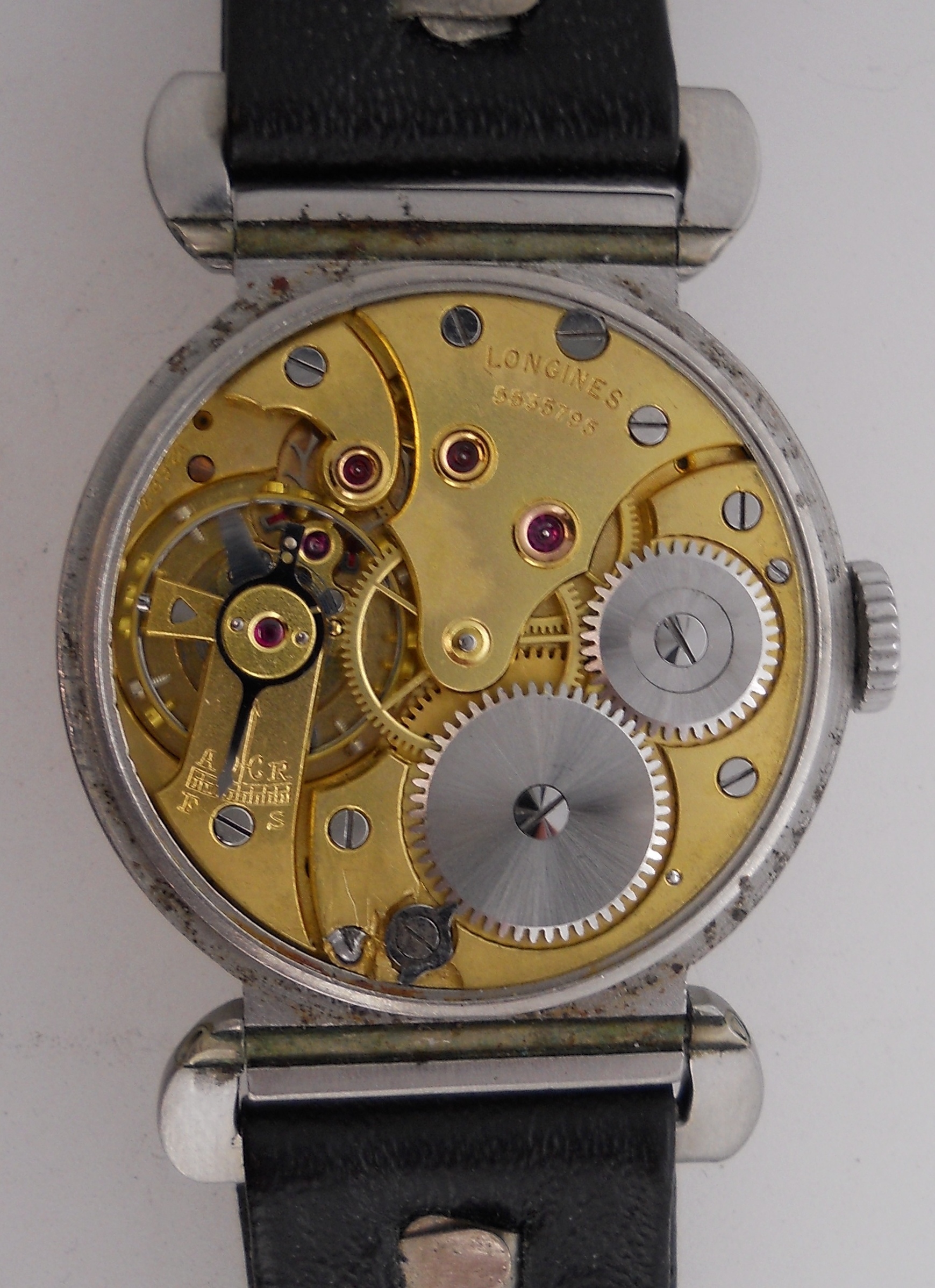
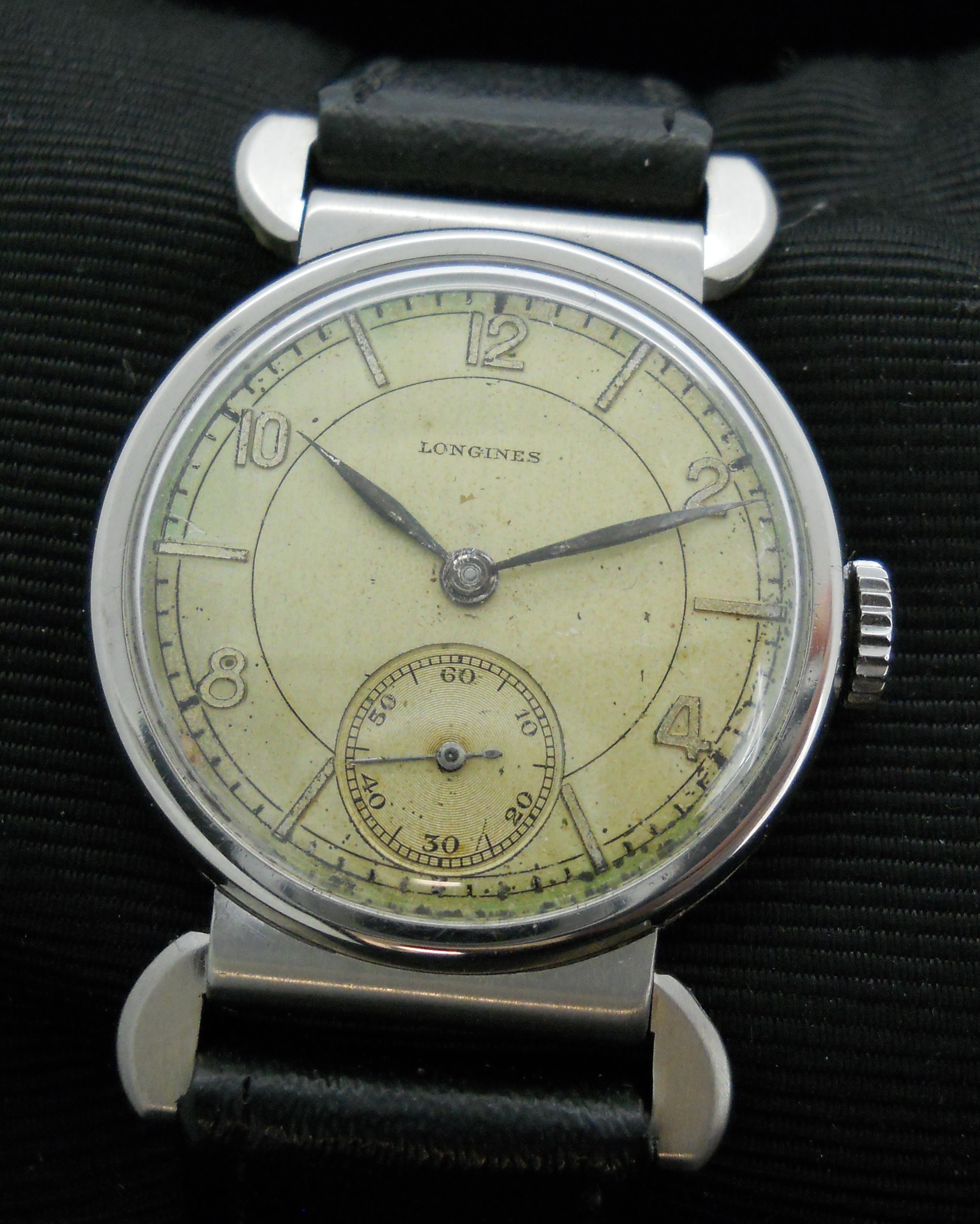
This very rare Longines was given to me by my auntie in Italy. It was in very poor condition but the important thing was that it was intact and, to my surprise, the balance staff was not broken.  It was a simple restoration; there was a little rust damage that was cleaned up, the movement was overhauled, the case polished up nicely. The glass was the only part I replaced. The only thing I couldn’t improve was the dial without having it repainted and that would have destroyed the watch’s authenticity.

I was surprised to find how old this watch is, but its exact age proved a little hard determine. The serial number suggested 1937; a reliable reference tells me that the 12.68Z movement started production in 1938 and the style suggests to me the early 50’s. There is a repair number scratched into the back (watchmakers routinely scratched a mark into the inside of the back to record a repair. Sometimes this includes the date) dated 1941. So it is positively pre 1941; I’m going with 1937.

What makes this watch distinctive and rare at a time when watches were indistinctive, is the swivel lugs, they make for a very pleasant look on the wrist because the lugs curve to the wrist shape.  Remove the lugs and it would be like all other watches of the period.

The movement is fine quality with a bimetallic balance and timing washers for accurate adjustment but ordinary in the sense that all reasonable quality watches had these features.

But this is no ordinary watch….it’s a Longines.

Posted in Longines | Tagged , , | Leave a comment

Omega 18ct gold 1947

Feb 2013 021

I seem to be drawn more and more to this brand and, when I think of it, founded in 1848, and at the forefront of design and innovation ever since, it’s no wonder. As a watchmaker in the 70’s, many Omegas from the 40’s to the 60’s crossed my bench and with strong, quality components that were exceptionally well finished, they were a delight to service. Omega also had, and still has, very good spare parts back up.

In 1947, the two most desirable features in a watch was a sweep hand and shock resistance. This watch has both and with an 18ct gold case, this watch was definitely aimed at the well to do.

Feb 2013 007The 30T2SCPC movement, which became the 260 in 1949, was an amazing piece of simple engineering, old, tried and true technology made to an exceptionally high standard. Over 3 million of these movements were produced from 1940 to 1963.
This watch was a dress watch but big, bold and noticeable. If it was dropped onto a tiled floor, the incabloc shock absorber would protect it. The wearer would remove it if he was doing anything vaguely physical so its lack of water/dust resistance was not a problem.

This watch gets very little wrist time, but if I do wear it, it’s a special occasion. Recently I wore it to the opening night of a local production of “Phantom of the Opera”

Posted in 18ct Gold, Omega | Tagged , , , | 2 Comments

Cartier Santos

DSCN6859  DSCN6860

Although Cartier has genuine pedigree, being founded in 1847, the brand has never been technically innovative. Cartier is a high fashion brand whose strength seems to have been in quality and innovative design. For me, never really that exciting.
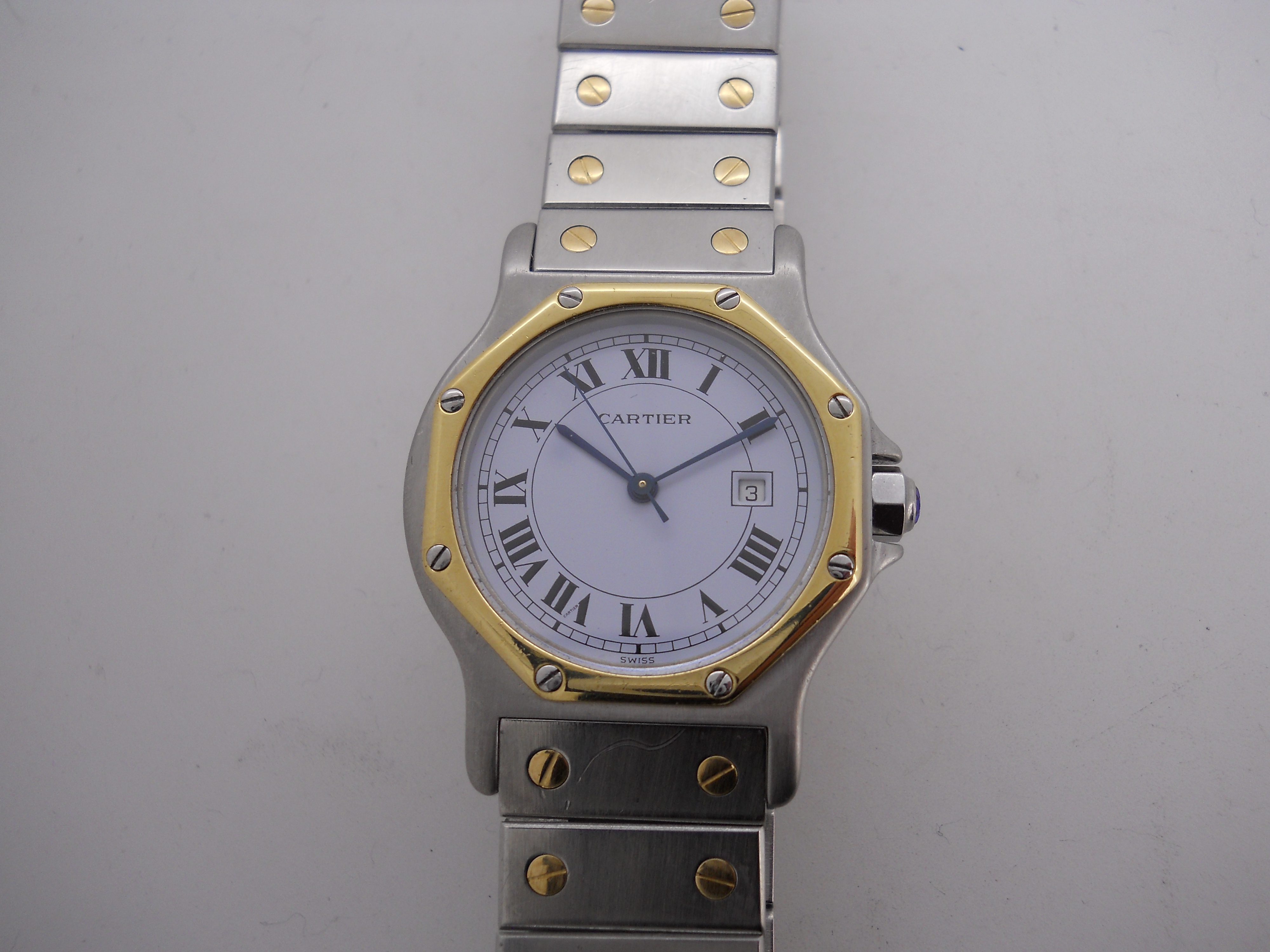
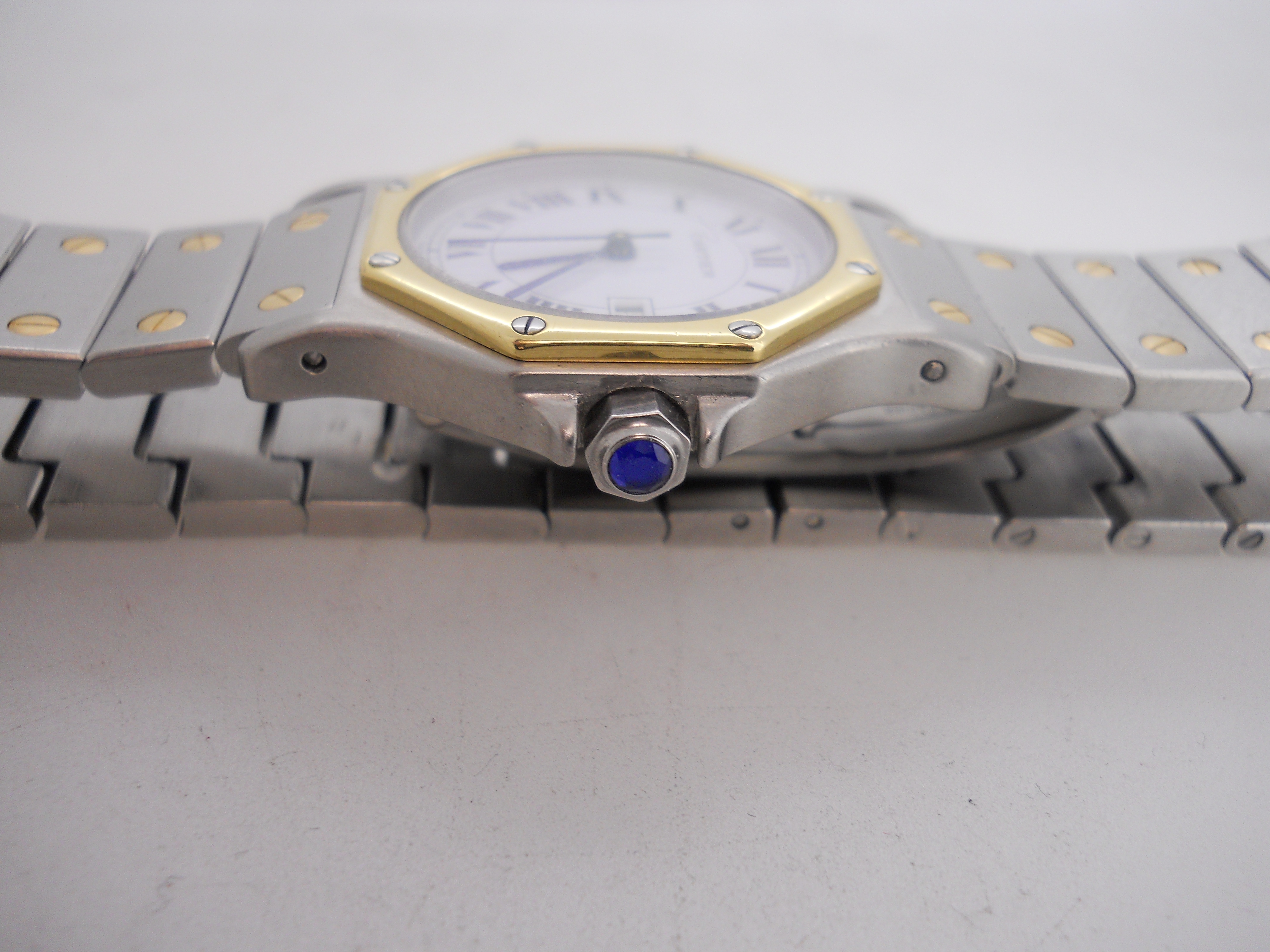
This is a Santos model from around 1988, very small for a gent’s watch, 30mm across including the crown. It is very distinctive with the octagonal 18ct bezel and the unmistakeable “Cartier” roman numeral dial. The bracelet is stainless steel with 18ct imitation screws set, that is imitation screws made from real 18ct. A nice touch is the sapphire set into the crown.
The movement is stated as Cartier 077 which is a rebadged ETA 2671, the ladies version of the ETA 2700 series.
On the back of this watch is etched AC 17.8gr and OR 0.750 2.3gr. This refers to the weight of the steel (in the case only) and the gold…..I’ve never seen this before.
The Cartier Santos first went on sale in 1911. It was designed by Louis Cartier, the Grandson of the company’s founder, who was asked by his Brazilian friend Alberto Santos-Dumont, an early aviation pioneer, to design a watch that could be used during his flights, since pocket watches were not suitable.
I think that this was the first gent’s wristwatch but how innovative was Louis? Ladies wristwatches where around since the middle of the previous century, so how hard was it to make one a little larger for a man?
Having said all that, I am pleased to have this very desirable (among the general public) watch in my collection and it has had a reasonable amount of wrist time.

Posted in Cartier | Tagged , , , , | Leave a comment

Tag Heuer F1 Chronograph

DSCN4367 DSCN4154

In 1985, turbocharge manufacturer, Techniques d’Avant Garde purchased the Heuer watch company and created TAGHeuer.

The Formula 1 was the first watch released, the name derived from the only thing the two brands had in common; an association with motor sport. Inspired by the Swatch success they where quartz, cheap, plastic, bright colours and tough. But, at the time and for decades following, they didn’t impress me.

They became more sophisticated, the Chronograph was introduced  in 1989, better materials were used, the styles were always distinctive, the prices went up and TAGHeuer became evermore desirable.

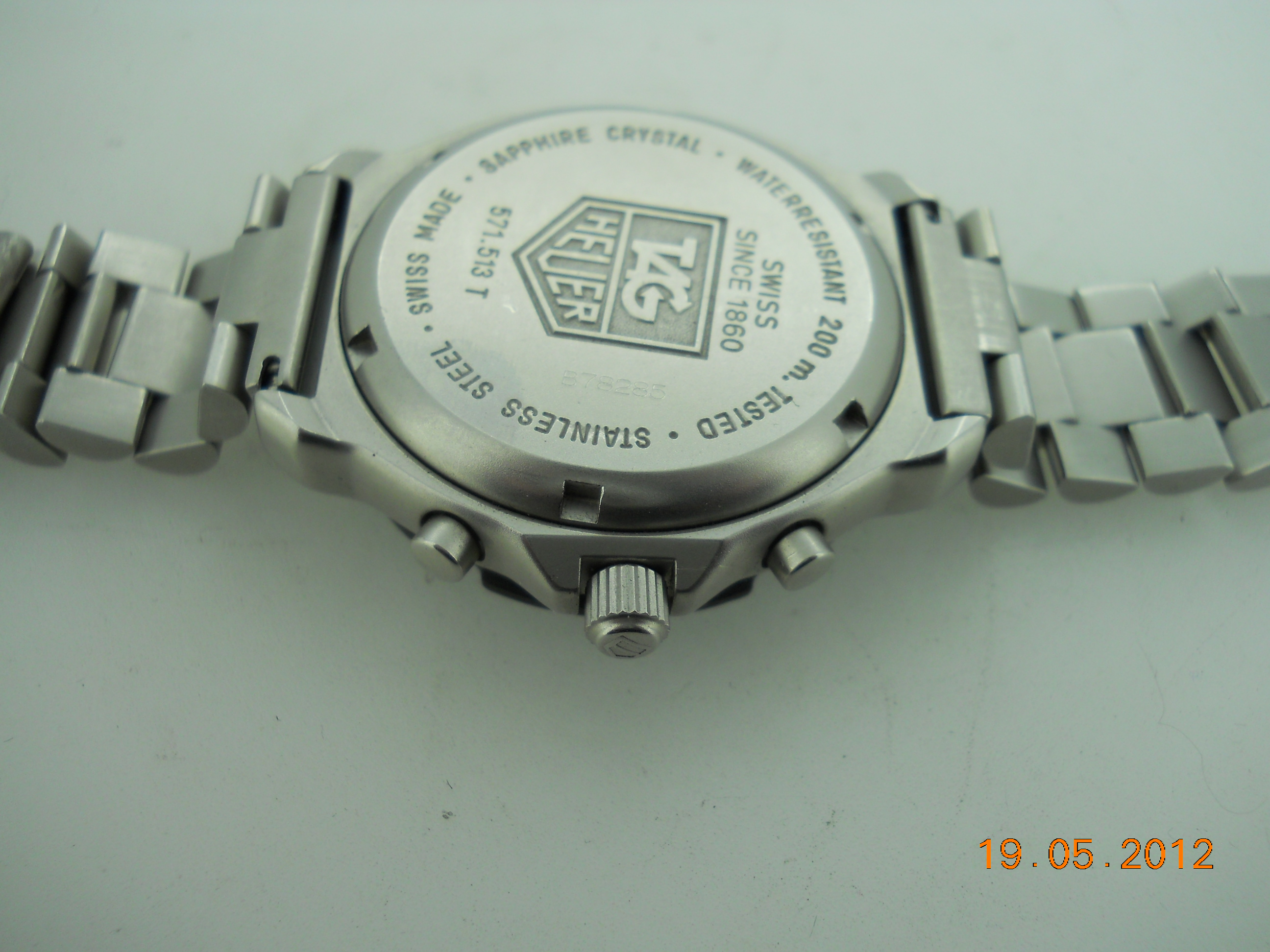
This Formula 1 chronograph is a beauty. I like its style, its perfectly comfortable size, and its features and functions. The ETA251-262 is possibly my favourite quartz chronograph, beautifully finished (by modern standards) and it has no less than 7 hands, 4 operating from the centre. I have the same movement in my “Buzz Aldrin” Bulova .

There’s something about the brushed finish on the stainless steel that feels good and looks great. It has a sapphire crystal and the whole thing feels tough without being bulky but they still use the hard plastic bezel! Looks great but plastic is plastic is plastic!!

I have a friend who has a Porsche Boxter; this is the watch for him.

Posted in Chronograph, Tag Heuer | Tagged , , | Leave a comment

Certina Dress 1978c

DSCF0027Watches 369This is what happened to most Swiss manufacturers in the late seventies.

In a last ditched attempt to stave off the Japanese conquest, that was in fact by now unstoppable, they cut corners and ride on their name.

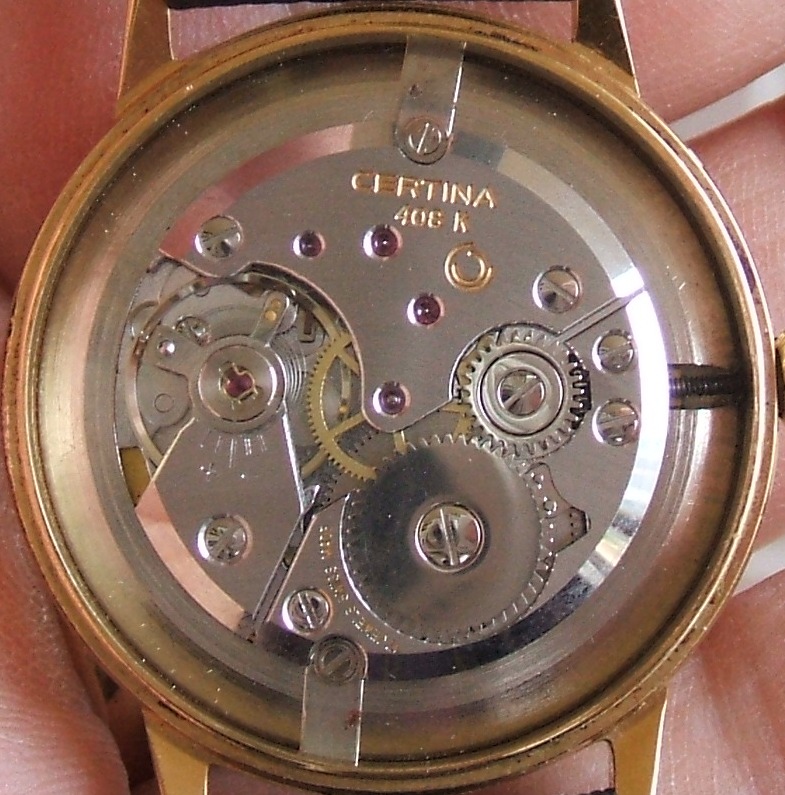
Certina, one of the most respected watchmakers, renowned for robust quality and impeccable finish, has in this model forsaken their own movement for this Peseux 1046. They try to cover this by stamping there own caliber No. 408K on the main bridge and finish it off with a good Certina nickel plated finish and the movement is clamped to the case making it quite solid. But it’s not a Certina movement.
It’s a dress watch without any seals. The dial is plain with thin elegant hands, no sweep hand, and the index markers are painted white to match the hands.

The dial is a nice brown with an iridescent look. The case is plain and thin. Overall, it’s a very nice dress watch but ordinary, ordinary in style and quality, any commercial brand could have marketed a watch like this.

Posted in Certina | Tagged , , | Leave a comment

Citizen Crystal 7 1967

DSCN2032 DSCN2019The Citizen Crystal 7 was a groundbreaker in the mid to late sixties. It looked good, was packed with features and at about A$65 (a little less than a tradesman’s weeky wage), it was very well priced (typical of all Japanese products of the time).

Let’s look at the  features:

The movement was automatic wind and one of the slimmest around, It displayed the day as well as the date (rare in Swiss watches).

The date could be set quickly with the winding stem (a feature lacking in most Swiss watches).

It had an auxiliary manual wind (arch rival, Seiko, did not).

But the feature that really sold this watch was its crystal glass.  Just about all watches at the time had perspex glasses even though the technology for toughened glass and even sapphire crystal had existed for decades.

Termed crystal, it was in fact toughened glass and the technology came from optical lenses (the name Crystal 7 comes from a type of borosilicate glass called BK7). It looked very sharp, was scratch resistant (much more so than perspex) and could be nicely fashioned.

The case was “waterproof”, the Citizen parashock system made it “shockproof” and most models came with an integrated metal bracelet. With the day displayed at 12 o’clock and the date at 3, this watch was quite distinctive and with beautifully polished index markers, hands and day/date window frames, it was a nice looking timepiece.

As far as market share went, there was a problem…..it was Japanese!  At a time when Japanese products where not trusted, the average consumer would happily pay half as much again for a (often inferior) Swiss product.

But it was watches like this; attractive, reliable, accurate and feature packed, that brought the Swiss watch industry to its knees in less than two decades.


Posted in Citizen | Tagged , , | Leave a comment

Certina DS 1960

Certina holds a special place in horological history from the early 50s through to the mid 70s. Apart from DS (I will elaborate) there weren’t any standout designs and there were few technological breakthroughs, but the movements were so well finished and strong and the cases were likewise well constructed that (I’ve said it before) the brand was a favorite among watchmakers.

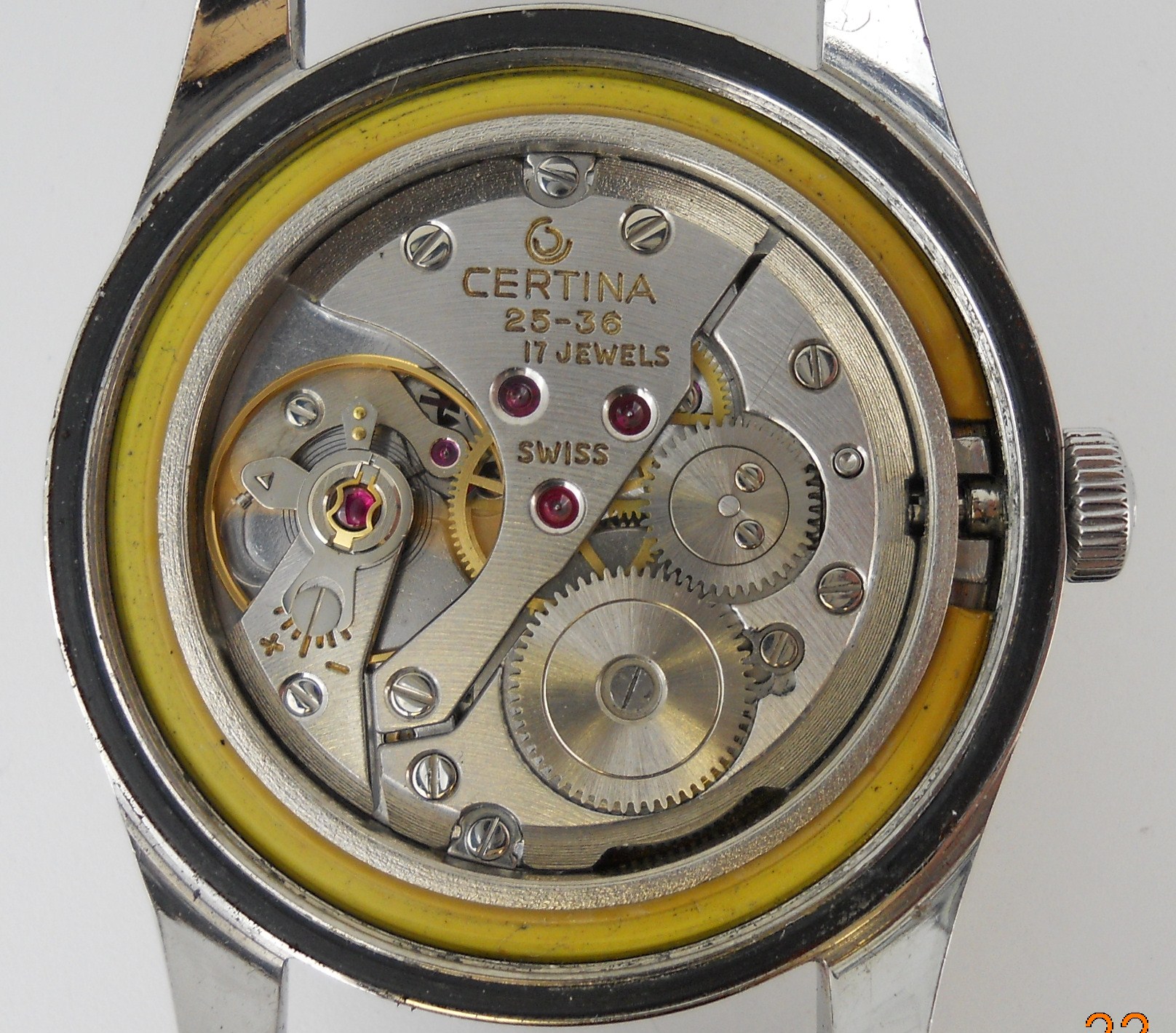
Having said all that, Certina in the mid fifties, set out to design a wristwatch as rugged as possible. The result was the DS models. DS stands for “Double Safety”. This was achieved by a floated mounting of the entire movement with an elastic shock absorber ring in addition to the conventional shock absorber (Incabloc). Aside from that, there was an air gap between the dial and case. So, in the case of a severe shock, the movement could move in all directions and sestain no damage. Other features were additional sealings, an extra thick and sheathed plexiglass, combined with the enhanced caseback.

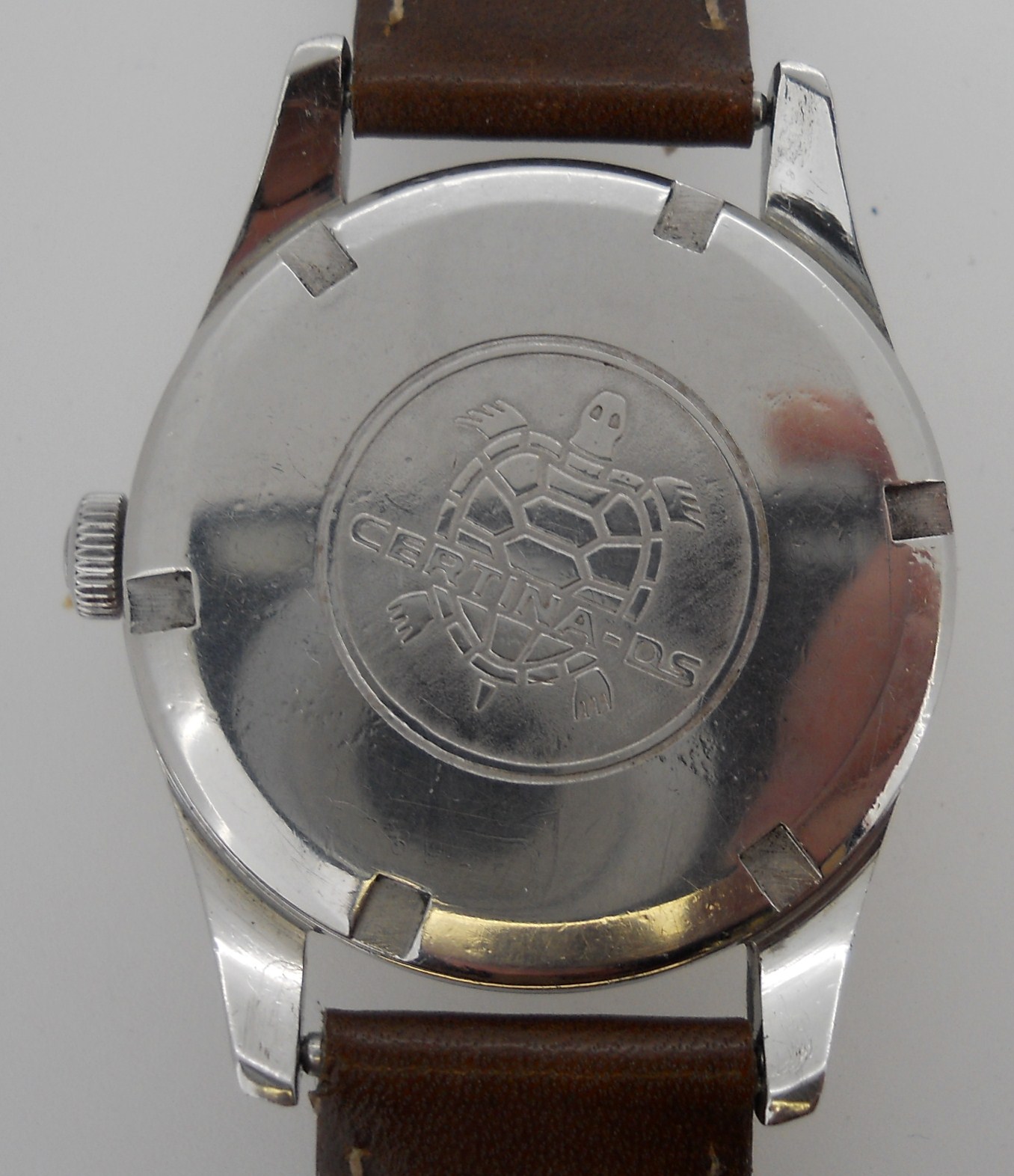
The DS was released  in 1958 and used this 25-36 manual wind movement only until 1960. The first models had a plain back but from 1960, the famous turtle was engraved on the back. So this watch, with the turtle, must be a 1960 model.

I have always been a great fan of Certina. And of all the Certinas, the DS is the most desireable. I discovered that they where hard to find in the condition that I consisder acceptable and it took years. But, finally, here it is, slightly aged dial, scratched case and apart from the band, all original. Signed four times; dial, movement, crown and back.

The Certina DS is a very special watch.

Posted in Certina | Tagged , , , , | 2 Comments