
This watch is a monster!
 When I showed it to a colleague, she broke out into a chant “I’m late! I’m late for a very important date.” Of course, this evoked images of the rabbit in Alice in Wonderland sporting a ridiculously large watch similar to the one I was holding.

This watch reminds me of this!
It is an interesting and unique timepiece and it came to me reputed to have been a Scottish stationmaster’s watch. Nothing else is known, it is completely unsigned. It is big, 67mm in diameter and 21mm thick. I found a picture of one on the Science Museum Group website and it was said to have come from The London Midland & Scottish Railway (LMS) which existed from 1923 to 1947.
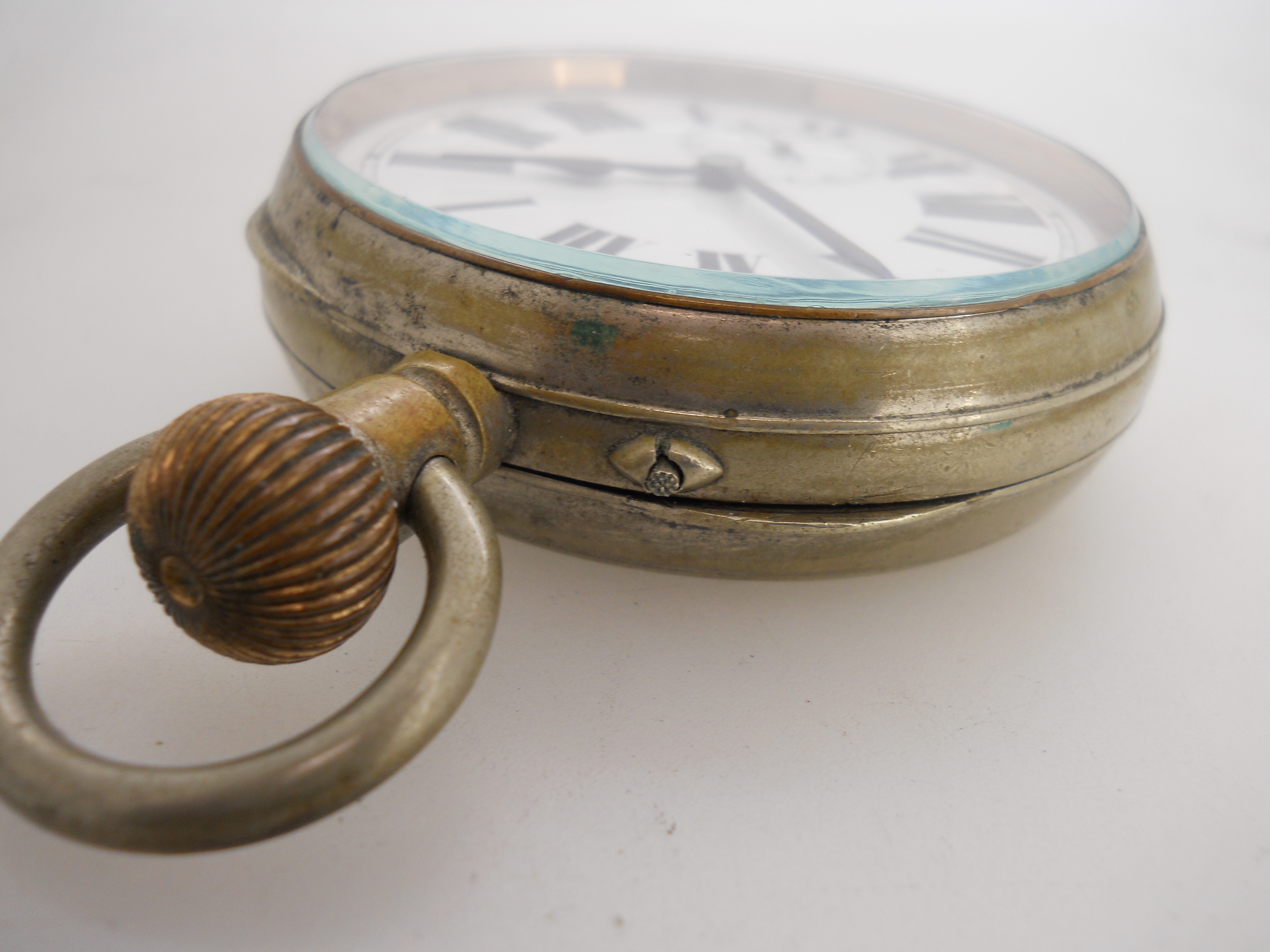
The tiny pin set which is depressed with a finger nail to change the time
The movement is standard, mid quality early 20th century with a bi metallic balance, timing screws and 15 jewels. Rather than the time being set by pulling the crown out, this watch is set by the pin set system in which the time is set by depressing a tiny button, just left of the crown and then turning the crown while the button is depressed. This button sits in a slot so only a fingernail can press it down. This system was used extensively from the mid to late 1800’s until sometime after the start of the 20th century.
The dial is in mint condition, rare for enamel dials because they often show hair line cracks with age and suffer from chips with shocks. The roman numerals are very heavy and the dial is surrounded by a fine chapter ring. There is a beautifully proportioned sub second dial and the hands a heavy spade style made of blued steel.
There’s no doubt about the purpose of this watch with maximum black/white contrast and large bold markings, it’s designed to be read easily at a glance under even the dimmest conditions, in an intense industrial environment.
The case looks rough, tough and ordinary. It’s made of gunmetal, has a flat bevelled glass. The back is hinged as is the inner dust cover and in addition a further cover made of glass, this I have not seen before in a pocket watch.
 Despite this watch’s very rugged case and all-round big, tough appearance, it is very fragile. I have not tested this and I don’t intend to, but I doubt if it would stand a drop of 30cm onto a firm surface. The balance staff and the glass would break and the enamel dial would either chip or crack.
I do like this watch for several reasons, most of all because it is unique and mysterious but also because it is a railway watch and great advances in horology where made during and because of the development of railways. I’ll be writing an article about that soon.

 robswatches