
A Stepping Stone to a Giant Leap Forward
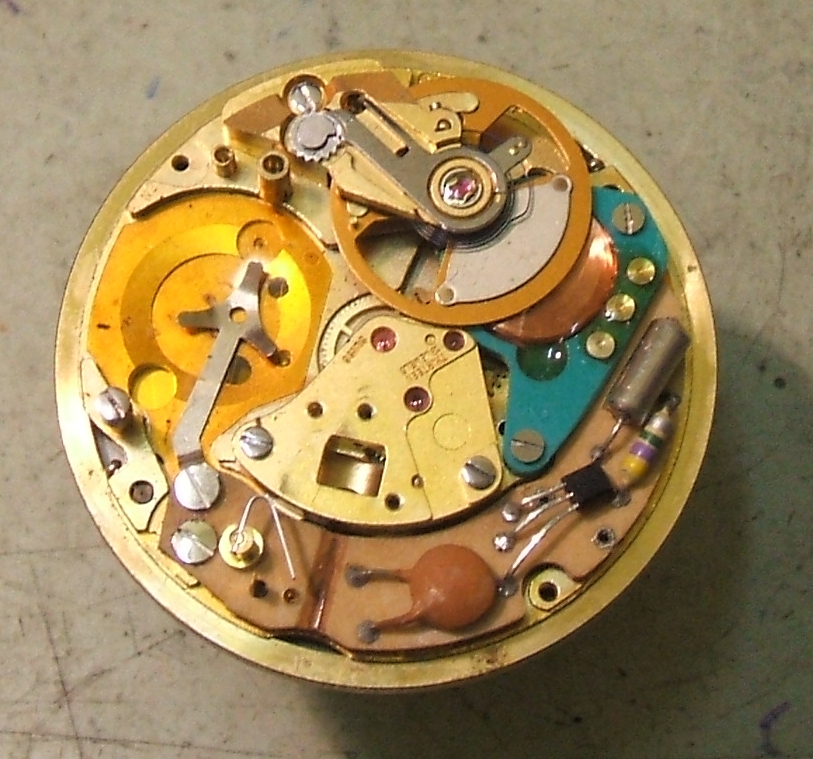 In 1969 I went to the RMIT (Royal Melbourne Institute of Technology) as part of my apprenticeship and we studied this movement.
It was the first time I had seen an electro-mechanical watch. My thoughts where that electronics where not going to replace mechanical.
Quartz technology was still experimental, both digital and analogue, and was mega expensive.
These electro-mechanical things didn’t seem much of threat either, I saw them as not much more than a novelty.
They worked in the opposite direction to the mechanical; the balance was driven by electro magnets that transferred movement to the hands through a train. The number of gears was the same as a mechanical, minus the mainspring barrel. The balance was very heavy with two magnets and two counter weights. It was bulky and less robust than an automatic. The battery lasted about a year and the only advantage I could see was
  continuous operation, whether worn or not, for the life of the battery. Also, it could be adjusted to run quite accurately, about the same as a good quality mechanical but I think it was more consistent over time.
This technology was never an alternative to the tried and tested mechanical and soon, it was to be superseded by the all conquering quartz that swept all before it aside.
This example is from the early 70’s when bulk was good and the style suits the thick movement.
The Avia is in great condition and a good example of advancing technology of the period.

 robswatches